
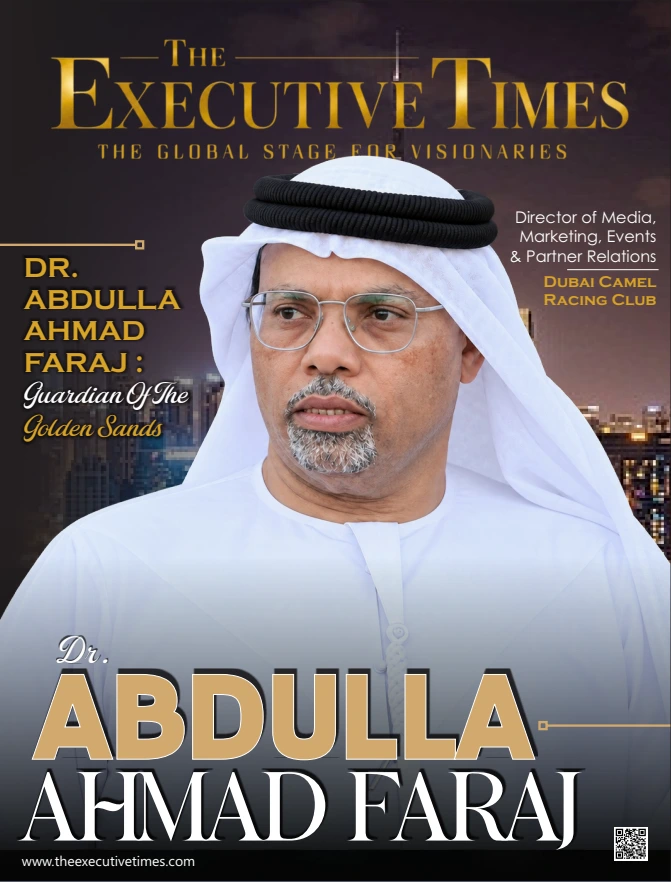
Cover Story -
Dr. Abdulla Ahmad Faraj
Director of Media, Marketing, Events & Partner Relations, DUBAI CAMEL RACING CLUB
"Dr. Abdulla Ahmad Faraj : Guardian Of The Golden Sands"
MY STORY, IN MY OWN WORDS
When the team at The Executive Times invited me to write freely, in my own words, about what I genuinely wanted readers to know about me and my journey, I found myself facing a question I had rarely asked in quite this way: What do I truly want people to know?
Should I begin with positions? Achievements? Awards? Projects? Partnerships? The people I met along the way? All of those matter, but none of them felt like the real beginning. If I was going to write honestly, I wanted to begin somewhere deeper than a conventional professional profile.
I wanted to write about how my understanding of work, leadership, responsibility, heritage and legacy changed over the years. I wanted to write about a sport I never planned to make such a large part of my life, and how I eventually found myself thinking about it long after the working day had ended. I wanted to write about Emirati heritage, camel racing, the racecourse, the people, the relationships, the media, the partnerships, the events, the ideas that began as simple questions and later became real projects.
Most of all, I wanted to write about one lesson that has stayed with me: not everything that enters our lives by chance remains a matter of chance. Sometimes you walk into a place without knowing that it will change the way you think. Sometimes you begin a job and the job gradually becomes a mission. Sometimes you go somewhere because your responsibilities require you to be there, and years later you find yourself wanting to arrive before everyone else.
That is almost exactly what happened to me with camel racing.
THE APPOINTMENT THAT CHANGED THE DIRECTION OF MY JOURNEY
My relationship with camel racing did not begin as a childhood plan or a carefully mapped professional ambition. It began after I was appointed Director of Media, Marketing, Events & Partner Relations at Dubai Camel Racing Club. That appointment brought me into a world I had not expected would become so central to my professional identity and personal sense of purpose.
At first, I attended the races because my role required me to understand the field, the events, the audiences, the operational environment and the people who make the sport what it is. I was there every day. I watched closely. I listened. I asked questions. I paid attention not only to what happened on the track, but to everything surrounding it.
Then something changed. The more I watched, the more I understood. The more I understood, the more deeply I became attached to the sport. Before long, I was among the first to arrive on race days. I stopped looking at the clock. My thoughts no longer ended when the official working day ended. I would leave the racecourse and continue thinking about the next event, the next visitor, the next campaign, the next partnership, and the next idea.
That shift is important because it explains the difference between holding a role and feeling responsible for a mission. A role has a description. A mission follows you beyond the description. A role tells you what must be done. A mission keeps asking what more can be done.
From my earliest days at the track, that question stayed with me: What more can we do?
FROM DUTY TO PASSION
I often think about the point at which professional duty becomes personal commitment. It rarely happens in one dramatic moment. It happens gradually, almost quietly, through repetition, understanding and emotional connection.
For me, that transformation happened at the racecourse. I began to see camel racing as far more than a sporting competition. I saw history moving in front of me. I saw a relationship between people, animals and the desert that had shaped generations. I saw discipline, patience, endurance and pride. I saw communities and families connected to a tradition that had survived because it remained meaningful.
At the same time, I saw possibility. I saw a sport that could speak to visitors from outside the region. I saw an experience that could become part of Dubai’s cultural and tourism story. I saw opportunities for media, hospitality, partnerships, digital communication, international collaboration and education. I saw a heritage that did not need to remain confined to those who already understood it.
That was when I stopped thinking only about how to manage what already existed. I began thinking about what could exist if we developed the experience more deliberately.
I would ask myself: If someone comes to a camel race for the first time, what do they see? Do they see only a competition? Or do they understand why this sport matters? Do they feel the culture around it? Do they leave with a stronger understanding of the UAE? Do they want to return? Do they tell others about the experience?
Those questions became part of my daily thinking. They shaped how I approached events, media, marketing, partnerships and visitor engagement. They also changed my relationship with work itself. I was no longer interested only in completing tasks. I became interested in building experiences and relationships that could continue to create value long after a single event was over.
WHAT LEADERSHIP MEANS TO ME
My definition of leadership has changed significantly over the years. Earlier in a career, it is easy to associate leadership with authority, position or the ability to make decisions. Experience taught me that those things are only the visible surface.
Leadership, to me, is responsibility.
It is responsibility for the decision and for the consequences of the decision. It is responsibility for people, not only performance. It is responsibility for the culture you create around you. It is responsibility for what happens when you are present and, equally important, for what happens when you are no longer present.
One of the questions I now ask myself is: Am I building an institution that depends on me, or am I helping build an institution that can succeed without depending on me?
That question changed my approach to management. I do not believe the strongest leader is the one everyone must wait for. I believe the strongest leader is the one who develops people until they can think, decide, represent the institution and carry responsibility with confidence.
Leadership is not keeping knowledge close to yourself. It is transferring knowledge. It is giving someone the context behind a decision, not only the instruction. It is allowing younger colleagues to attend important discussions, take on greater responsibility, make mistakes within a safe environment, learn from them and grow.
I am proud when a member of the team no longer needs to ask me a question they once needed help answering. That is not a reduction in my value. It is evidence that capacity has been built.
A project ends. A season ends. A title ends. But a person who became more capable, more confident and more prepared to lead can continue creating value for years. That is why developing people is not a secondary leadership task. It is part of legacy.
THE LEADERSHIP MODEL I LOOK TO
My understanding of leadership has been profoundly shaped by the environment in which I have had the privilege to live and work. I have always looked to the UAE’s wise leadership as a model of ambition, excellence, future-readiness and confidence in national identity.
In the UAE, we are constantly encouraged not merely to complete a task, but to ask whether it can be done better. The idea of being number one is not, to me, simply about a ranking. It is a mindset. It is a culture of refusing complacency, comparing ourselves with the highest standards, and understanding that yesterday’s success cannot become an excuse for standing still today.
That mindset influenced me deeply. If an event succeeds, I think about the next edition. If a partnership works, I ask how it can become deeper and more strategic. If media performance is strong, I ask which audiences we have not yet reached. If a visitor experience is good, I ask what would make it exceptional.
This is not perfectionism for its own sake. It is a sense of responsibility. When you represent an institution in Dubai and work with a heritage that forms part of the UAE’s national identity, ordinary is not the standard you want to accept.
Our leadership has also shown us that modernization and identity are not opposing choices. The UAE has built a globally competitive future while maintaining deep confidence in its roots. That lesson has shaped my own view of camel racing. I do not believe we must choose between heritage and innovation. I believe our responsibility is to make them strengthen one another.
The lesson I carry is simple: think big, prepare for the future, invest in people, preserve what defines you, and never assume that what was excellent yesterday is automatically good enough for tomorrow.
MY RELATIONSHIP WITH EMIRATI HERITAGE AND CAMEL RACING
Camel racing became personal to me because I gradually understood that it is not simply a sport. It is part of the story of the UAE.
To someone seeing it for the first time, a camel race may appear to be a competition on a track. To us, there are deeper layers behind that image. There is history. There is the desert. There is patience and endurance. There is a relationship between people and their environment. There are values carried through families and communities. There is a memory of how earlier generations lived, adapted and built their lives.
The camel itself holds a special place in the history of this region. The relationship between people and camels was not symbolic. It was practical, cultural and deeply human. That history gives modern camel racing a meaning that cannot be understood through sporting results alone.
This is why I feel a different kind of responsibility when I work in this field. We are not only organizing sport. We are dealing with part of a national memory.
But memory survives only if it remains connected to life. If heritage is separated from people and placed behind glass, we may preserve its appearance while slowly losing its meaning. If, on the other hand, we modernize without understanding the roots, we may preserve visibility while losing the soul.
The challenge is balance. We must protect authenticity while making heritage accessible to a generation that lives in a world of smartphones, artificial intelligence, global media and instant information. We cannot ask young people to experience the past exactly as earlier generations did. We can, however, help them understand why it matters.
For me, that is the real sustainability of heritage: not forcing the next generation to preserve something because they were told to, but helping them understand it well enough that they choose to carry it forward.
THE HERITAGE VILLAGE: FROM EVENT TO EXPERIENCE
One of the initiatives I am particularly proud to have developed was the programme of accompanying events surrounding Dubai’s major seasonal camel racing festivals, including the development and enhancement of the Heritage Village as an integral part of the festival experience.
My objective was to expand the visitor experience beyond the racecourse itself, creating a richer cultural environment where camel racing, Emirati heritage, traditional hospitality, tourism, entertainment and community engagement could come together within one integrated festival experience.
The idea grew out of a simple observation. The race is the heart of the occasion, but it does not have to be the entire experience. If a visitor comes to Al Marmoom, what happens before the race? What do they see after it? What helps them understand the context? What gives them a memory that is larger than the result of a particular race?
I wanted visitors to enter an environment that brought them closer to Emirati culture. I wanted them to encounter heritage, hospitality and traditional elements in a way that made the visit richer and more meaningful. The goal was not to create decoration around the sport. The goal was to create context.
For me, the Heritage Village represented a principle: living heritage must be experienced, not merely displayed.
If an international visitor comes because they are curious about camel racing, watches the race, explores the heritage village, experiences Emirati hospitality, asks questions, learns something about the relationship between people and camels, and leaves understanding the UAE differently, then the festival has achieved something larger than sport.
That changed my view of event management. I stopped seeing events only as schedules, stages, guests, logistics and programmes. I began seeing them as designed experiences. Every detail matters because every detail contributes to how a person feels and what they remember.
This is also where tourism, culture, media and heritage begin to intersect. A well-designed heritage event can become a form of cultural diplomacy. It can show the world a side of Dubai that complements the city’s global image: a Dubai that is innovative and modern, yet deeply connected to the desert, to tradition, to hospitality and to national memory.
WHEN WORK BECOMES PART OF IDENTITY
There is a stage in a long professional journey when work stops being something you simply do and becomes part of the way you see the world. I reached that stage gradually with camel racing.
At the beginning, I was learning a new environment. I needed to understand the rhythm of race days, the expectations of audiences, the responsibilities of media and events, the language of the sport, and the relationships surrounding it. Every day added another layer of understanding.
Then the field began to follow me beyond the field.
I would notice something during a race and think about it later in the evening. I would see a visitor hesitate because they did not understand a part of the experience and begin thinking about how information could be made clearer. I would watch a successful activation and ask what would make it stronger next season. I would see a partner’s interest and think about how a one-time relationship might become strategic.
This is when I understood that passion in professional life is not simply enthusiasm. It is sustained attention.
When you truly care about something, you notice details that other people may not notice. You are not satisfied with saying, “The event happened.” You ask whether it created the experience it was supposed to create. You are not satisfied with saying, “The content was published.” You ask what the audience understood. You are not satisfied with saying, “The partner signed.” You ask whether the relationship is strong enough to continue.
This also explains why I became so interested in the small details of the racecourse and the festivals around it. I learned that the public experience is created by dozens of things that may never appear in a final report: the clarity of a sign, the timing of a programme, the way a guest is welcomed, the accuracy of a caption, the readiness of a team before the gates open, the information available to an international visitor, the speed with which an unexpected issue is handled.
The audience may not know which detail made the experience feel professional. They simply feel the result.
That lesson stayed with me. Excellence is often invisible in its components and visible only in its effect.
My relationship with the Club also changed with time. After many years, an institution in which you spend a major part of your professional life becomes more than a workplace. It becomes connected to memories, seasons, projects, colleagues, pressures, achievements and relationships. There are mornings you remember, conversations that began as small ideas, people who worked beside you and later moved to other chapters of their lives, and projects that taught you something about yourself.
For me, Dubai Camel Racing Club became a professional home and the field became a place where many parts of my thinking were tested in reality.
It also taught me not to become distant from the ground. Strategy is essential, but strategy becomes stronger when it remains connected to reality. I believe a leader should not allow seniority to separate them completely from the place where the experience actually happens.
Reports can tell you many things. Data can tell you many things. But sometimes you need to walk through the venue, speak to people, watch where visitors stop, listen to the questions they ask and see how the plan behaves outside the meeting room.
The field does not flatter the plan. It tells you the truth.
That is one reason I still value being close to execution. The closer you remain to the real experience, the more accurately you can decide what should change and what should remain.
Over the years, this way of thinking turned camel racing from an area of responsibility into part of my professional identity. It did not happen because I was required to say that I loved the sport. It happened because I came to understand it, and through understanding it, I became genuinely invested in its future.
I sometimes think this is a lesson that applies beyond my own story. We often tell young people to find their passion as though passion must exist before the work begins. My experience was different. Sometimes passion comes after commitment. You enter a field, give it your attention, learn its meaning, understand the people around it, and only then discover that it has become important to you.
That is why I never underestimate the opportunities that arrive unexpectedly. Chance may open the door. What we do after the door opens is what turns chance into a journey.
THE EXPERIENCES THAT CHANGED MY PERSPECTIVE
Several experiences changed the way I think, but one of the earliest and most important was the moment I realized that the story of camel racing could travel beyond its familiar audience.
From my first period at the racecourse, I kept thinking about how this sport could be developed and promoted internationally. I did not want international promotion to mean changing the sport into something it was not. I wanted to test whether authenticity itself could travel.
My first major experience in that direction came through our long-term relationship with a German sports organization. What began through sport became something much larger. The relationship continued for more than a decade and showed me that trust can cross language, geography and culture.
The importance of that experience was not simply the visibility of Dubai Camel Racing Club in Germany and Europe. It was what that visibility could trigger. Someone sees the name or the identity of the Club and asks: What is camel racing? Why does it matter in the UAE? How has a traditional sport remained meaningful within one of the world’s most modern countries?
A question becomes curiosity. Curiosity becomes knowledge. Knowledge can become respect.
That experience confirmed something I had hoped was true: heritage does not need to surrender its identity in order to become internationally relevant. It needs to be presented with confidence, context and consistency.
It also changed the way I thought about partnerships. I saw that a relationship could begin with a specific sporting purpose and, if handled with care, become a bridge between cultures. I learned that a contract can end while a relationship continues. I learned that the strongest partnerships are not measured only by what they deliver in the current year, but by what they are still capable of creating years later.
FROM SPONSORSHIP TO STRATEGIC PARTNERSHIP
Another major part of my journey was the evolution of how I approached sponsors and partners.
I began by bringing companies into the camel racing environment as sponsors. In the early stages, as is common in events, some relationships were connected to a specific season, festival or activation. Those relationships were useful and important, but over time I began asking a different question: Why should the relationship end when the event ends?
Why should a sponsor remain only a logo? Why should successful cooperation not become a long-term strategic relationship? Why should we think only about what the institution needs from the company and not also about what the company needs from the institution?
This changed my approach.
I began thinking from both sides. What are the partner’s objectives? Who is its audience? What kind of value is it seeking? How can its presence become part of the experience rather than simply an advertisement placed beside it? How can we create a relationship in which both sides grow?
The partnerships I value most are the ones that have endured. Longevity is evidence. It tells you that trust has been built, commitments have been respected and both parties continue to see value.
A one-season sponsorship can be a success. A relationship that continues for more than a decade becomes part of institutional memory.
I have also learned that partnership is not created by the contract. The contract records the agreement. Trust is built in everything that happens after the signature: communication, responsiveness, honesty, delivery, problem-solving, and the way both sides behave when something does not go exactly as planned.
That is why I often say that relationships should not begin only when you need something. The strongest professional relationships are built during the ordinary days, not only at the moment of need.
THE CULTURE OF FIRST PLACE
One of the strongest influences on my professional mindset has been the culture of excellence created by the UAE’s wise leadership.
Living and working in the United Arab Emirates means seeing ambition translated into action around you. You see a country that does not treat the future as something to wait for. It prepares for it, invests in it and builds toward it. You see a leadership philosophy that repeatedly asks institutions and people to raise their expectations of what is possible.
That environment changes the way you think.
The phrase “number one” can be misunderstood if it is reduced to competition or ranking. For me, its deeper meaning is responsibility. It means refusing to become comfortable with yesterday’s standard. It means having the courage to compare your work with the best, not only with what is familiar. It means understanding that once you achieve something, the question is no longer whether you can repeat it, but whether you can improve it.
I have tried to apply that mindset within my own field.
When we organize a festival, I do not want the benchmark to be only the previous edition. I want to understand what the best visitor experiences in the world are doing. When we develop media, I do not want to think only about producing more content. I want to think about whether the content is more useful, more credible, more international and more meaningful. When we build partnerships, I do not want to measure success only by the immediate value of the agreement. I want to know whether the relationship has the quality to grow and endure.
This mindset also affects how I think about national representation.
When you work with Emirati heritage, the standard is not purely operational. The way you communicate, welcome, organize and deliver contributes to the way people experience the UAE. That creates a positive pressure: the work should be worthy of the country it represents.
I have always been inspired by the UAE’s ability to combine confidence in identity with confidence in innovation. This is a particularly important lesson for people working in heritage.
If our national model had suggested that progress requires us to distance ourselves from tradition, then heritage institutions might naturally see technology and globalization as threats. But the UAE has demonstrated something very different. It has shown that a nation can build the future at extraordinary speed while remaining proud of its language, traditions, values and cultural memory.
That gives me a framework for decision-making.
When I ask whether we should use a new technology, I do not ask whether it is traditional. I ask whether it serves our purpose without weakening our identity.
When I think about international promotion, I do not ask how to make camel racing look more like something the world already knows. I ask how to explain what makes it uniquely ours in a language the world can understand.
When I think about younger generations, I do not ask them to live the past. I ask how we can help them understand the past well enough to carry its values into a future that will be very different.
The culture of first place also teaches discipline.
Ambition without discipline becomes a slogan.
Excellence requires preparation, measurement, learning, accountability and repetition. It requires people to do the invisible work before the visible moment. It requires institutions to build systems, not only celebrate individual effort.
That is why I believe one of the best ways to honour the example of our leadership is not through words alone, but through standards.
Be prepared.
Improve continuously.
Invest in people.
Use the best tools available.
Protect identity.
Think beyond the next season.
And when success comes, treat it as the beginning of another responsibility.
This philosophy has also made me more optimistic about the future of heritage in the UAE. We are not trying to preserve heritage in a society that is afraid of change. We are preserving it in a society that has learned how to use change.
That is a powerful advantage.
Our challenge is to make sure that the speed of progress does not reduce the depth of memory. If we can keep the two together, we can build something remarkable: a future that is technologically advanced, globally connected and unmistakably Emirati.
THE PEOPLE AND RELATIONSHIPS THAT SHAPED ME
No one builds a long professional journey alone.
When I think about the people and relationships that shaped me, I think first about the example set by the UAE’s leadership and the culture of excellence it has created. I also think about colleagues, team members, government partners, corporate partners, media professionals, international contacts and people who challenged my thinking.
Some people shape you by giving you confidence. Others shape you by disagreeing with you. Some teach through advice. Others teach through the standards they set. A younger colleague may teach you something about a new platform or technology. An experienced colleague may help you understand the institutional context behind a decision. A partner may show you the value of patience. A difficult negotiation may teach you the importance of listening.
One of the most important things I learned is that relationships are a form of professional capital, but not in the sense of collecting contacts. I do not believe the value of a network is measured by the number of names in a phone.
The real question is: What kind of relationship did you build?
Is there trust? Is there mutual respect? Does the relationship continue after the immediate project ends? Can the person call you even when there is no transaction between you? Do you communicate only when you need something, or is there genuine professional respect over time?
Those are the relationships I value.
I also learned that people often remember how they were treated more clearly than they remember what was said in a meeting. Respect is not a soft extra in leadership. It is part of performance. People who feel respected are more likely to speak honestly, take responsibility, contribute ideas and stay committed under pressure.
WHAT I HAVE LEARNED ABOUT PEOPLE
No matter how sophisticated an institution becomes, people remain the force that moves it. Strategies can be written, technologies can be acquired, budgets can be allocated, systems can be designed, but none of them create impact without people who understand the purpose and believe in what they are doing.
Large festivals taught me this very clearly. The public sees the final event. It does not always see the journalists, photographers, camera crews, editors, translators, designers, operational teams, committees, government entities, strategic partners, security teams, hospitality teams and many others who make that final picture possible.
This is why I resist the idea of institutional success as the achievement of one individual. Leadership may provide direction, but the ecosystem delivers the result.
I believe the leader should be the first to accept responsibility when something goes wrong and the last to monopolize credit when something goes well.
I also believe a team needs psychological safety. If an employee is afraid to tell you that there is a problem, then you do not have a strong organization. You have an organization that may be hiding reality from itself.
I want people to be able to say, ‘We have a problem.’ The first question should be: How do we solve it? Accountability matters, but accountability should improve the system, not create a culture in which people hide mistakes.
I value initiative. I value people who do not only bring a problem but try to think about a solution. I value someone who can say, “I do not know, but I will learn.” I do not expect everyone to know everything. I expect a willingness to grow.
Some of the most rewarding moments in leadership are quiet. Seeing a person who once needed close guidance become capable of guiding others is one of them. That kind of progress may never appear in a public report, but it is one of the strongest indicators that leadership has created real value.
THE LESSONS I LEARNED FROM CHALLENGES
No honest account of a long career should present it as a continuous sequence of success.
There were difficult periods. There were ideas that took longer than expected. There were projects that required repeated explanation and persuasion. There were moments when time pressure was intense, when plans changed at the last minute, and when the work demanded more patience than I expected.
There were also times when I felt that the effort being made was greater than the recognition being received. Those experiences taught me an important lesson: external recognition is meaningful, but it cannot be the only source of motivation.
If you work only when you are being applauded, your motivation will always depend on something outside your control.
I learned to return to the question: Why am I doing this?
If I believe the work has value, I continue. Recognition is welcome when it comes, but the value of the work must exist before the recognition.
Challenges also taught me patience. Trust cannot be rushed. Institutional change cannot always be rushed. Developing people takes time. International relationships take time. Some ideas need years before their full value becomes visible.
At the same time, I learned that patience is not passivity. There are moments when speed matters. Technology is changing quickly. Audience expectations are changing quickly. Artificial intelligence is changing the way organizations operate. Leadership must know when to be patient and when hesitation becomes a risk.
I also learned that pressure reveals culture. It is easy to talk about teamwork when everything is calm. The real test comes when something changes shortly before an event, when a deadline is tight, or when a problem appears without warning.
In those moments, a team needs clarity more than noise. A leader who adds panic to pressure creates a second problem. A leader who helps people focus on the solution gives the organization a chance to respond intelligently.
THE VALUE OF LISTENING AND CHANGING YOUR MIND
Experience made me value listening more, not less.
Sometimes people assume that the more senior a leader becomes, the more they should speak. I have learned the opposite. Experience should make you more aware of what you do not know.
The person working directly with visitors may see a problem that is invisible from the office. A younger colleague may understand a platform better than a senior manager. A partner may identify a gap in an activation that the internal team has normalized. A visitor may ask a simple question that reveals that the information we thought was clear is not clear at all.
The leader who does not listen deprives the organization of knowledge.
I also learned that changing your mind after receiving better information is not weakness. It is responsibility.
There is a difference between persistence and stubbornness. Persistence means staying committed to the goal while changing the path when necessary. Stubbornness means staying committed to the path even when the evidence says it is wrong.
This distinction matters in innovation. Not every new idea will work. Not every old idea should be kept simply because it once worked. Experience should be a guide, not a prison.
I want to remain curious. I want to keep asking why, how and what if. Those questions have shaped much of my journey.
Why should a sponsorship end after one event? How can a heritage festival become a broader experience? How can an Emirati heritage story travel internationally? What if artificial intelligence could make decades of institutional memory searchable and accessible?
Curiosity turns routine into possibility.
THE QUIET LESSONS NO AWARD CAN SHOW
The lessons that shaped me most are not always the ones that appear in biographies.
A biography records positions, qualifications, projects and awards. It rarely records the long day when a problem had to be solved quietly before anyone noticed. It does not record the meeting in which an idea was rejected and had to be explained again months later. It does not record the partner relationship that needed years of patience before it became strong. It does not record the moment a team member made an error and the leader had to decide whether to create fear or create learning.
Yet those moments shape leadership.
I learned that consistency matters more than occasional intensity. Anyone can be highly motivated for a short period. The real test is whether the quality of your work remains strong during ordinary weeks, difficult periods and moments when the public is not watching.
I learned that trust is fragile. It may take years to build and very little time to damage. That applies to partners, employees, government relationships, audiences and institutional reputation.
I learned that the fastest solution is not always the right solution. Pressure creates a temptation to solve the visible problem without considering the long-term effect. Experience taught me to ask whether a quick decision will create a larger problem later.
I learned that recognition and contribution do not always arrive at the same time. Sometimes a person works for years before the value of an idea becomes obvious. Sometimes someone else receives the public credit for a process many people helped build. If your motivation depends entirely on immediate recognition, these moments can become destructive.
I had to learn to separate the value of the work from the timing of the recognition.
I also learned that disappointment can either narrow a leader or deepen them.
It can make a person more defensive, more controlling and less willing to trust. Or it can make them more reflective, more patient and more aware of what truly matters.
I try to choose the second path.
There were moments when I had to remind myself that an institution is larger than one difficult day, one disagreement or one delayed result. Returning to the larger purpose helped me keep perspective.
Another quiet lesson was that the strongest leaders do not need to prove that they know everything.
There is freedom in being able to say, “I need more information,” or, “This person understands this subject better than I do.”
A leader who must always be the smartest person in the room will eventually make the room less intelligent. People stop offering ideas. Specialists stop challenging assumptions. Younger colleagues learn to remain silent.
I do not want that kind of environment.
I want the designer to know that I respect their design expertise. I want the media professional to know that their editorial judgement matters. I want the technology specialist to tell me when my assumption is outdated. I want the operational team to tell me what is happening on the ground even if the answer is inconvenient.
This requires humility, but it also produces better decisions.
I learned that leadership is often most visible in what you choose not to do.
Not blaming someone publicly when a problem can be corrected constructively.
Not taking credit that belongs to the team.
Not promising a partner something you know cannot be delivered.
Not exaggerating an achievement for attention.
Not adopting a technology simply because it is fashionable.
Not changing heritage simply because a more dramatic version may generate more clicks.
These choices rarely receive awards, but they build credibility.
I also learned that professional energy must be renewed. A long career can become routine if curiosity disappears.
For me, renewal comes from learning, new ideas, young people, international relationships, technology and the continuing question: What more can we do?
That question has prevented familiarity from becoming complacency.
Perhaps the most important quiet lesson is that work should leave people stronger, not smaller.
If someone worked with me for years, I hope they gained confidence, knowledge and opportunity. If a partner stayed with us, I hope the relationship created value on both sides. If a visitor attended an event, I hope they left with more understanding. If an institution gave me responsibility, I hope it became stronger because I was part of it.
These are not always measurable in a spreadsheet.
But they are the measures I increasingly care about.
MEDIA: FROM COVERING EVENTS TO BUILDING MEANING
Media has been central to my professional journey, but my understanding of media has also changed over time.
At the most basic level, media tells people what happened. How many stories were published? How many videos were produced? How many people watched? How much engagement did the content generate?
These metrics matter. Reach matters. Visibility matters. But numbers do not tell the whole story.
The deeper question is: What did the audience understand?
A camel racing video can receive a large number of views. That is a digital success. But if the same content helps someone in Europe, Asia or America understand why camel racing matters to Emirati culture, we have achieved something more valuable.
We have created understanding.
For me, media in a heritage context must work on both levels: reach and meaning.
I want people to see the sport, but I also want them to understand the story behind it. I want them to know that the race is connected to history, environment, community and national identity. I want media to become a bridge between a local story and a global audience.
This is why multilingual communication matters. It is not enough to translate words literally. International communication requires translating context. A local audience may already understand terms, traditions and references that mean nothing to a first-time international reader.
If we want to communicate globally, we must help people enter the story without simplifying it so much that it loses depth.
The goal is not to make heritage more dramatic by changing it. The goal is to make its truth understandable enough that people discover why it is already compelling.
MEDIA AS MEMORY
There is another dimension of media that became increasingly important to me: documentation.
Media does not speak only to today’s audience. It creates the archive through which tomorrow may understand today.
A photograph taken now may become a historical document twenty years from now. A video may be watched by a generation that was not yet born when the race took place. A magazine may become a research reference. An interview may preserve the memory of a person whose knowledge would otherwise disappear.
This is why accuracy matters: names, dates, context, images, language and preservation.
An institution can have a long history and many achievements, but if it does not document them, it can lose part of its memory each time people move on.
My interest in publications and long-form content came partly from this belief. Digital platforms give us speed and reach. Print and long-form editorial work can give us permanence and depth.
I do not see the two as competitors. They serve different purposes.
A short video may attract someone to the story. A long article may help them understand it. An archive may allow a researcher to return to it decades later.
The institution of the future should not simply produce more content. It should build a structured memory.
I would like to see a future in which the history of camel racing in Dubai is supported by a rich digital archive: images, race records, publications, films, oral histories, interviews, event records and institutional milestones that can be searched and explored intelligently.
That would not be an archive of files. It would be an archive of identity.
FROM LOCAL HERITAGE TO GLOBAL RELEVANCE
I have always been interested in the international dimension of camel racing because I do not believe global relevance requires us to become less local.
In fact, I believe the opposite.
The world is full of experiences that increasingly resemble one another. Authenticity has become more valuable precisely because it cannot be copied easily.
Camel racing does not need to become similar to another sport in order to be understood internationally. Its distinctiveness is part of its strength.
The challenge is to communicate that distinctiveness well.
The UAE itself demonstrates this principle. The country has become a global centre for business, tourism, aviation, technology, culture and sport without treating national identity as an obstacle to ambition.
That model gives me confidence.
We can be global and deeply rooted. We can learn from the best international practices in events, tourism, communications and technology without surrendering the things that make our story uniquely Emirati.
This is also how I think about Al Marmoom. I see enormous potential for it to become more widely recognized as a destination where visitors can discover an authentic side of Dubai.
The world already comes to Dubai. We do not always need to take the story to the world; sometimes the world is already here. Our opportunity is to open the door and invite visitors to discover the desert, camel racing, hospitality and heritage as part of the broader Dubai experience.
If a visitor comes to watch a race and leaves understanding something new about the UAE, that is cultural value. If they return home and tell others about what they experienced, that is also powerful communication.
FROM SPECTATOR TO AMBASSADOR
I do not see an international visitor as only another attendance number.
I see an opportunity.
For some visitors, a day at Al Marmoom may be their first encounter with camel racing. It may also be their first direct encounter with this dimension of Emirati culture.
How we welcome them matters. What information we provide matters. Whether they can understand the programme matters. Whether the experience is accessible in their language matters. Hospitality matters.
A visitor may forget some details of a schedule, but they remember how they felt.
If the experience is meaningful, the visitor can become an informal ambassador for the story. They may return home, speak to friends, share an image, post a video, or simply carry a different understanding of the UAE.
That kind of communication is powerful because it is based on lived experience, not advertising.
This is why I often say that the image in the visitor’s mind may be more important than the image we publish on social media.
The published image is controlled by us. The image in the visitor’s mind is created by the total experience.
Media, marketing, operations, hospitality and event design are therefore not separate worlds. They all contribute to reputation.
The best marketing promise is one the real experience can fulfil.
TECHNOLOGY AND ARTIFICIAL INTELLIGENCE IN HERITAGE INSTITUTIONS
We are living through an extraordinary technological transition. Artificial intelligence will change how institutions communicate, organize knowledge, analyze audiences, make decisions and deliver services.
I am interested in these possibilities because I do not believe heritage institutions should stand outside technological change.
On the contrary, they have much to gain.
Artificial intelligence can help us organize archives. It can make decades of information easier to discover. It can support multilingual communication. It can analyze audience interests. It can improve planning. It can automate repetitive work. It can enhance visitor services. It can support educational experiences. It can help institutions become faster and more intelligent.
I believe a significant share of services and operations can become smarter and more automated over the coming years.
But I have one principle that I consider essential:
Technology must serve identity. It must not become the author of identity.
Artificial intelligence can help us tell the story of camel racing. It has not lived the memory that gave the story meaning. It can analyze data about heritage. It cannot feel belonging. It can generate an image. It cannot take moral responsibility for whether that image is culturally truthful.
For that reason, the future I want is not human versus technology. It is human judgment strengthened by technology.
We may transform a large percentage of processes, but responsibility for values, truth, cultural meaning and institutional accountability must remain human.
The most important question is not, “What can AI do?” The more important question is, “What do we want AI to help us protect, strengthen and deliver?”
TRANSFORM THE PROCESS, PROTECT THE MEANING
I do not want artificial intelligence to become a slogan.
If an institution says it is transforming, the transformation should be visible in the quality of its services and the efficiency of its operations.
Which processes can be automated? Which repetitive tasks can be reduced? How can employees gain time for creative and strategic work? How can decisions use better data? How can visitors receive information more easily? How can international audiences engage with the story in their own languages?
These are practical questions.
At the same time, I do not want technology to become a performance in itself. The best technology in a visitor experience may be technology the visitor barely notices because it makes everything easier.
It helps them navigate. It explains the story in their language. It makes information accessible. Then it steps out of the way and allows the real experience to take centre stage.
The desert must still feel like the desert. The race must still feel real. The human welcome must still feel human.
In the future, authenticity may become even more valuable because artificial content will be easier to create. Images, videos and narratives can be generated in seconds. That increases the responsibility of heritage institutions to maintain authoritative records, documented sources and clear standards of truth.
Technology can recreate a visual impression of the past. It must not be allowed to invent a past that never existed.
The easier artificial creation becomes, the more valuable verified memory becomes.
THE NEXT GENERATION IS THE REAL TEST
When people speak about preserving heritage, they naturally think about the past. I increasingly think about the future.
Perhaps the most important audience for heritage is the generation that has not yet been born.
A child born years from now will encounter camel racing in a world very different from ours. Learning may be immersive. Information habits may be completely different. Artificial intelligence may be built into everyday life in ways we cannot yet imagine.
But one question will remain:
Will that child feel that this heritage belongs to them?
The answer does not begin in the future. It begins now.
It begins in how we document knowledge, how we tell stories, how we develop people, how we use technology, how we strengthen institutions and how honestly we preserve the meaning of the heritage itself.
I do not want future generations to preserve camel racing simply because they were told that they must.
I want them to understand why it matters.
I want them to understand what camels represented in the lives of earlier generations, how the desert shaped values of patience, endurance and adaptation, and how a heritage sport can remain culturally meaningful in one of the world’s most advanced societies.
At the same time, I do not expect them to present that heritage exactly as we do.
Every generation must find its own language.
They may use technologies we cannot yet imagine. That is not a threat. The essential task is to pass on the truth, the values, the documented memory and a strong institutional foundation – then trust them to carry the story forward in their own way.
YOUNG PEOPLE ARE NOT ONLY THE AUDIENCE OF THE FUTURE
We often say that young people are the future. That is true, but it is incomplete.
They are also partners in the present.
If we want heritage to continue, we should not only speak to young people. We should speak with them.
We should listen to how they consume information, how they use technology, what makes them curious, and what makes them feel that something belongs to them.
I do not want a young Emirati to preserve camel racing only out of obligation. I want them to understand it deeply enough to feel pride and ownership.
That means giving them opportunities to participate – as content creators, researchers, designers, volunteers, innovators and future leaders.
It also means trusting them.
We cannot say that we want the next generation to lead while refusing to give them responsibility.
At some point, knowledge has to be transferred. Opportunities have to be real. Younger colleagues need to sit in the room, understand the context, take decisions, represent the institution and learn from experience.
The goal is not to create copies of ourselves.
The goal is to create people with strong foundations who will go further than we did.
A leader should not fear being surpassed by the next generation. If the next generation cannot surpass us, the institution is not progressing.
MY VISION FOR THE FUTURE
When I think about the future of camel racing, I do not imagine a choice between authenticity and modernization.
I imagine stronger authenticity, wider reach and a smarter experience.
I want the sport to remain faithful to its roots while becoming easier for the world to discover and understand. I want visitors to have better access to information. I want international communication to become stronger. I want archives to become more intelligent and searchable. I want partnerships to become deeper. I want technology to remove barriers between the audience and the heritage rather than become a barrier itself.
I also see potential for Al Marmoom to become more widely recognized as an integrated heritage destination.
Imagine a visitor who, before arriving, can understand the race programme in their language, learn the basics of the sport, and discover the cultural context. When they arrive, they experience the real race, the environment, hospitality and heritage. Technology supports the visit but does not dominate it. Afterward, they remain connected through digital content and archives.
That is the kind of future I find exciting: the past and future present in the same experience without either one cancelling the other.
I also want to see stronger links between heritage, tourism, education, technology and international cultural partnerships. Camel racing can be more than a sporting event. It can be a platform through which the UAE tells an authentic story about itself.
This is not a vision of turning heritage into a commercial product. Economic value and cultural value can support one another, but cultural truth must remain the foundation.
THE FUTURE OF AL MARMOOM
Al Marmoom has a special opportunity because it sits within Dubai, one of the world’s most connected and internationally recognized cities.
Dubai is known for its skyline, aviation, tourism, technology, business and major events. I want visitors to understand that there is another dimension to the city as well – a dimension connected to the desert, camel racing, hospitality, memory and Emirati identity.
I do not see those two Dubais as opposites.
They are one story.
The Dubai that knows its roots is the same Dubai that moves confidently toward the future.
For that reason, I see Al Marmoom as a potential bridge between modern Dubai and authentic Dubai.
I would like visitors to recognize it not only as a racecourse, but as a destination where they can encounter living Emirati heritage at a world-class level of organization.
Authenticity does not require lower standards. In fact, an authentic experience in Dubai should also be excellent in the way it is organized, communicated and delivered.
This is where tourism, hospitality, heritage, media and technology can work together.
The race remains real. The culture remains real. What improves is access, context, service and understanding.
RECOGNITION, AWARDS AND THE QUESTION THAT FOLLOWS
Over the years, my work has received regional and international recognition across leadership, media, strategic marketing, communication and heritage preservation.
I am grateful for every recognition. I do not take it for granted.
But I try to place recognition in the right position within the journey.
An award can document a moment. A magazine cover can celebrate a journey. A title can recognize a contribution. None of them can replace the work.
The morning after any recognition, the same questions return.
What can be improved? Which person can be developed? Which relationship can be strengthened? What new audience can be reached? How can technology be used more responsibly? What should the next season do better?
This is why I do not see recognition as a finish line.
I see it as additional responsibility.
The greater the trust, the greater the obligation.
I also do not see awards as individual achievements in the narrow sense. Behind every successful event, campaign, partnership or institutional initiative is a network of people. If my name appears on an award, I still think about the teams, colleagues, partners, government entities and institutions that made the work possible.
Recognition is valuable when it reminds us to thank the people behind the result and to raise the standard for what comes next.
WHAT I WANT READERS TO KNOW ABOUT ME
If readers remember only my positions, awards or titles, they will know part of my professional record, but they will not know the part of the journey that matters most to me.
I want them to know that I entered the world of camel racing unexpectedly and that I did not remain close to it by accident.
I remained because I came to love the sport, understand its cultural meaning and believe there was more that could be done to strengthen its future.
I want them to know that many of the ideas that shaped my journey began as questions.
How can the festival become a richer experience?
How can a sponsor become a long-term partner?
How can an Emirati heritage story travel to Europe?
How can media create understanding rather than simply attention?
How can technology preserve memory?
How do we make sure the next generation inherits something alive?
I also want readers to know that I do not consider this the story of one individual.
Every achievement was created within an ecosystem: the inspiration and vision of the UAE’s leadership, colleagues, teams, government entities, partners, media professionals, the camel racing community, and generations that preserved this heritage long before I became part of it.
My voice may be the one telling this story, but the work has always belonged to a much larger “we.”
WHAT I HOPE MY TEAM REMEMBERS
When I think about how I would like colleagues and team members to remember working with me, I do not want the first memory to be my title.
I hope they remember someone who respected the work and respected people.
Someone who expected high standards, but who also tried to support people in reaching those standards.
Someone who gave opportunities.
Someone who listened.
Someone who wanted success to belong to the team.
Leadership requires firmness. Deadlines matter. Quality matters. Responsibilities matter. But firmness does not require losing humanity.
You can address a mistake without humiliating the person who made it. You can hold people accountable without creating fear. You can demand excellence and still create an environment in which people feel safe enough to speak honestly.
I also hope they remember that I was pleased to see them grow.
One of the best outcomes of leadership is seeing someone who once required close direction eventually become the person directing others.
Positions are temporary. The way people felt they were treated can remain in their memory for a very long time.
WHAT I WOULD SAY TO SOMEONE BEGINNING THEIR CAREER
If a young professional at the beginning of their journey reads this story, I would tell them not to worry if they do not know exactly where the journey will end.
I did not plan for camel racing to become a central part of my professional life.
Be prepared for opportunities you did not plan for.
Show up. Observe. Ask questions. Learn. Do not treat any responsibility as too small to teach you something.
Do not make the title your only goal. Build yourself until the value you create becomes greater than the title on your business card.
Do not wait for applause before you begin.
If you believe in an idea, start with what you can do. Listen to criticism. Improve the idea. Be willing to change the path without giving up the purpose.
Respect time. Being busy is not the same as making progress. Some of the most important work is not urgent: building relationships, developing people, documenting knowledge, learning, and thinking long term.
And remember that professional reputation is built slowly.
Be consistent when no one is watching.
Arrive prepared.
Keep your word.
Give credit.
Accept responsibility.
If you make those habits part of your character, opportunities often follow.
FROM ACHIEVEMENT TO LEGACY
As the years passed, my definition of achievement changed.
Earlier in a career, achievement may mean completing the project, delivering the event, winning the partnership, reaching the target or receiving recognition.
Today, I think more about what remains.
An event can be an achievement. A model that allows the event to improve year after year becomes something closer to legacy.
Signing a sponsor can be an achievement. Building a relationship that continues for more than a decade becomes legacy.
Producing successful content can be an achievement. Building an archive that preserves institutional memory becomes legacy.
Developing someone for a task can be an achievement. Helping them become a leader becomes legacy.
This distinction matters to me because every professional role is temporary.
There will be a time when someone else holds the responsibility. When that time comes, I do not want them to begin from zero.
I want them to inherit stronger relationships, better documentation, clearer systems, capable people and a foundation from which they can go further.
The greatest compliment to one generation of leadership is not that the next generation repeats what it did.
It is that the next generation starts from where it finished and goes beyond it.
WHAT I WANT TO LEAVE BEHIND
The longer the journey becomes, the more I find myself thinking about what remains after the visible roles end.
Every position is temporary.
Every project has an opening day and a closing day.
Every racing season eventually reaches its final race.
Even the moments that feel very important today will one day become part of the archive.
That reality does not make the work less meaningful. It makes the question of legacy more important.
I do not think of legacy as something grand or ceremonial. I do not imagine it as a monument or a title permanently attached to a person’s name.
I think of legacy as usefulness that continues.
A system that works after the person who created it is gone.
A relationship that continues because it became institutional rather than personal.
An archive that allows a future researcher to understand a period they never witnessed.
A team member who becomes a leader and later develops others.
A festival model that improves because lessons were documented instead of forgotten.
A young person who feels closer to their heritage because someone created the right experience at the right moment.
These are the forms of legacy that interest me.
I also believe a leader should be willing to become less necessary over time.
At first, that idea may sound strange. Many people associate importance with being indispensable. But an institution that cannot function without one individual is vulnerable, no matter how talented that individual may be.
The better outcome is to build capability until the organization can perform strongly even when you are not in the room.
That requires knowledge transfer. It requires systems. It requires giving authority to others. It requires relationships that belong to the institution. It requires developing a second line of leadership before there is an urgent need for it.
I do not want the person who comes after me one day to rediscover everything from the beginning.
I want them to find something they can build on.
Strong relationships.
Organized knowledge.
Experienced people.
Clearer systems.
A culture that expects improvement.
A heritage story that is better documented and more internationally understood.
Then I want them to add things I never imagined.
That is important: I do not want the next generation to repeat me. I want them to exceed me.
The most successful generation is not the one future generations copy. It is the one that gives future generations a higher starting point.
This is also how I think about heritage.
We should not hand the next generation a fragile tradition and say, “Protect this exactly as we did.”
We should hand them something strong, understood, documented and alive. We should give them the context to know why it matters and the confidence to find their own methods of carrying it forward.
Legacy is therefore not control over the future.
It is preparation for the future.
You cannot decide every choice that future leaders will make. You cannot know which technologies they will use or how audiences will behave. What you can do is leave them a strong compass.
Authenticity.
Responsibility.
Trust.
Respect.
National identity.
Commitment to excellence.
If those values remain clear, the methods can evolve.
When I think about my own professional journey, I would be satisfied if people could say that something was stronger because I was part of it.
That the Club had stronger relationships.
That a visitor experience became richer.
That a partnership lasted.
That knowledge was documented.
That people were given opportunity.
That Emirati camel racing heritage became more visible internationally without becoming less authentic.
I do not need every contribution to carry my name.
In fact, one of the most beautiful forms of legacy may be an idea that becomes so naturally embedded in the institution that, years later, people no longer remember who first proposed it.
At that point, the idea no longer belongs to the person.
It belongs to the institution.
That is success at a deeper level.
My ambition today is therefore different from ambition at the beginning of a career.
I still want to achieve. I still want to innovate. I still want to see better events, stronger partnerships and wider international reach.
But I also want to create continuity.
I want to know that what we build has the strength to continue beyond the moment of recognition.
That, to me, is where achievement becomes legacy.
A LEGACY LARGER THAN ANY INDIVIDUAL
Ultimately, the preservation of camel racing should never become the story of one person.
This heritage existed before today’s generation, and if it is cared for responsibly, it will continue long after us.
Individuals contribute. Institutions organize. Leaders develop. Teams deliver. Partners support. Communities preserve. But heritage is larger than all of them.
That reality gives me a sense of humility.
I am not the owner of this heritage. I am someone who was given an opportunity to serve it during a particular period.
That is both a privilege and a responsibility.
No meaningful contribution to heritage is complete unless it becomes part of something collective and sustainable.
Leadership may provide direction. People turn direction into reality.
A leader may open a door. The team walks through it and carries the journey forward.
This is where the difference between achievement and legacy becomes clear.
An achievement may be associated with an individual. A true legacy must eventually belong to the institution, the community and the generations that follow.
Heritage is not protected by one person. It is protected by generations that believe it matters.
BEYOND THE FINISH LINE
There is a quiet parallel between camel racing and leadership.
The audience sees the race. It does not see everything that came before it: the years of knowledge, the preparation, the patience, the small decisions and the days when no one was applauding.
Leadership is much the same.
People see achievements. Awards. Photographs. Public moments.
But legacy is not built during moments of recognition.
It is built between them.
It is built when a value is protected even though compromise would be easier. When a relationship is maintained after the immediate commercial interest has passed. When knowledge is shared instead of protected. When another person is given the opportunity to succeed. When the right solution is chosen instead of the fastest one. When the impact of a decision is considered in years, not only days.
Eventually, perhaps the most important question any leader can ask is simple:
What will remain after me?
For me, the answer should not be a list of positions, awards or titles.
I would rather see a heritage protected without being frozen in the past.
An institution strengthened without losing its identity.
A heritage sport introduced to the world without changing its soul.
Partnerships that grew beyond agreements to become bridges between people and cultures.
Technology and artificial intelligence used to serve humanity and identity rather than replace them.
People who were given the knowledge, trust and opportunity to carry responsibility themselves.
A generation given reasons to value what it inherited rather than simply being instructed to preserve it.
And another generation, not yet born, prepared to inherit something living, authentic, meaningful and worthy of carrying forward.
That is the idea that extends beyond any position, any recognition and any individual.
Roles end. Names change. Generations move forward. But values can endure. Institutions can endure. Stories can endure. Heritage can endure – if every generation understands that preserving it is not simply an act of respect for the past, but an investment in the identity of the future.
My relationship with camel racing began by chance. But after all these years, I can say that remaining close to it is no longer a matter of chance. It became a choice, a passion, a responsibility and part of a mission I believe in.
If there is one legacy I hope to leave, it is that I contributed, together with everyone who shared this journey, to delivering this authentic Emirati heritage to the next generation stronger, more visible, more capable of speaking to the world, and still true to its spirit.
In camel racing, every race has a finish line.
In heritage, there is no final finish line.
There is only one generation handing something precious to the next.
And beyond the finish line, that is where the real responsibility begins.