
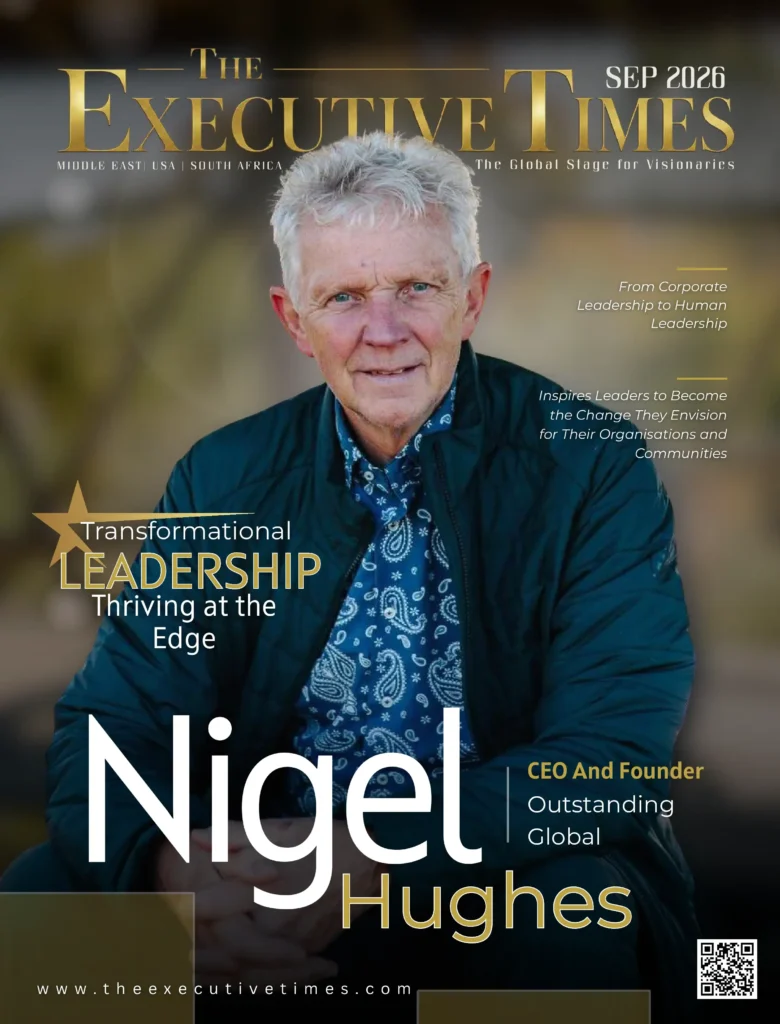
Cover Story -
Nigel Hughes
CEO And Founder of Outstanding Global
"Transformational Leadership: Thriving at the Edge"
Nigel Hughes: Inspires Leaders to Become the Change They Envision for Their Organisations and Communities
Leadership is often described in terms of capability. Experience, expertise, strategic thinking, decision-making, and the ability to deliver results define an effective leader. Yet Nigel Hughes, CEO and Founder at Outstanding Global, believes there is another dimension that is frequently overlooked: the capacity to express who you are as a leader fully. For more than three decades, he has worked with founders, C-suite executives, senior teams and emerging leaders at moments when capability alone is no longer enough. His work begins with a deceptively simple question: what happens when a leader has the experience and competence to move forward, but something within their leadership remains unexpressed?
That question sits at the heart of his philosophy and the work of Outstanding Global, the organisation he founded in 2019. Its proposition is deliberately different from conventional leadership development. He does not describe his work as training. He describes it as transformation. The distinction is more than semantics.
Training can equip people with techniques, frameworks, and knowledge. Transformation asks something deeper of the individual. It asks leaders to examine how they show up, what they stand for, what they are willing to say, and whether their behaviour genuinely reflects their values and ambitions. In his words, the journey is about moving “from experience to expression” and “from capability to presence.” It is an approach shaped not only by decades of executive-development work but by a career that has consistently crossed boundaries between business, performance, social impact, sustainability and personal development.
Unison of Leadership and Performance
Long before Nigel began working with corporate leaders, he trained as an actor, singer and dancer at Bristol Old Vic Theatre School and spent years performing across theatre and television. At first glance, performance and executive leadership might appear to occupy entirely different worlds. The connection is fundamental for him.
Performance taught him that presence cannot be reduced to technique. A technically competent performer may know the words, understand the movements, and execute every part correctly, yet still fail to connect with an audience. What creates impact is something more difficult to quantify: authenticity, energy, conviction, and the ability to bring the whole self into the moment. That understanding became increasingly relevant as Nigel moved into leadership development.
The modern executive operates in an environment where communication is constant, scrutiny is high, and expectations are increasingly complex. Leaders are expected to communicate strategy, inspire people, navigate uncertainty, create cultures, manage competing interests, and represent a sense of purpose. Yet simply knowing how to perform these responsibilities does not necessarily create meaningful leadership. Leadership is not about putting on a performance. It is about removing the barriers that prevent a leader from expressing what is already within them. This is why his work focuses on presence and authenticity rather than merely adding another layer of technique.
From Corporate Leadership to Human Leadership
Nigel’s career with Maynard Leigh Associates, where he served as Director of Leadership and Founding Associate for almost three decades, placed him at the intersection of leadership development and organisational transformation. During that period, he worked with major organisations and senior executives, contributing to leadership initiatives designed to strengthen performance, confidence, communication, commercial awareness and organisational effectiveness.
His work included leadership programmes for organisations such as EY, Barclays Group, Visa, Burtons Biscuits and Maybourne, alongside coaching and development engagements involving senior leaders at organisations including Capgemini, Biogen, Lightsource bp and Barclaycard. But the breadth of his experience is perhaps more revealing than the names themselves.
Across different sectors and leadership levels, he has encountered a recurring pattern: highly capable people could still become constrained by the very structures, expectations and habits that had helped them succeed. Success can create its own form of caution.
A leader who has built a reputation for competence may become reluctant to take a risk with their voice. Someone promoted into a larger role may continue operating according to the expectations of their previous position. A senior team may understand that its culture needs to change while remaining attached to behaviours that made sense in an earlier chapter. The challenge is not always a lack of knowledge.
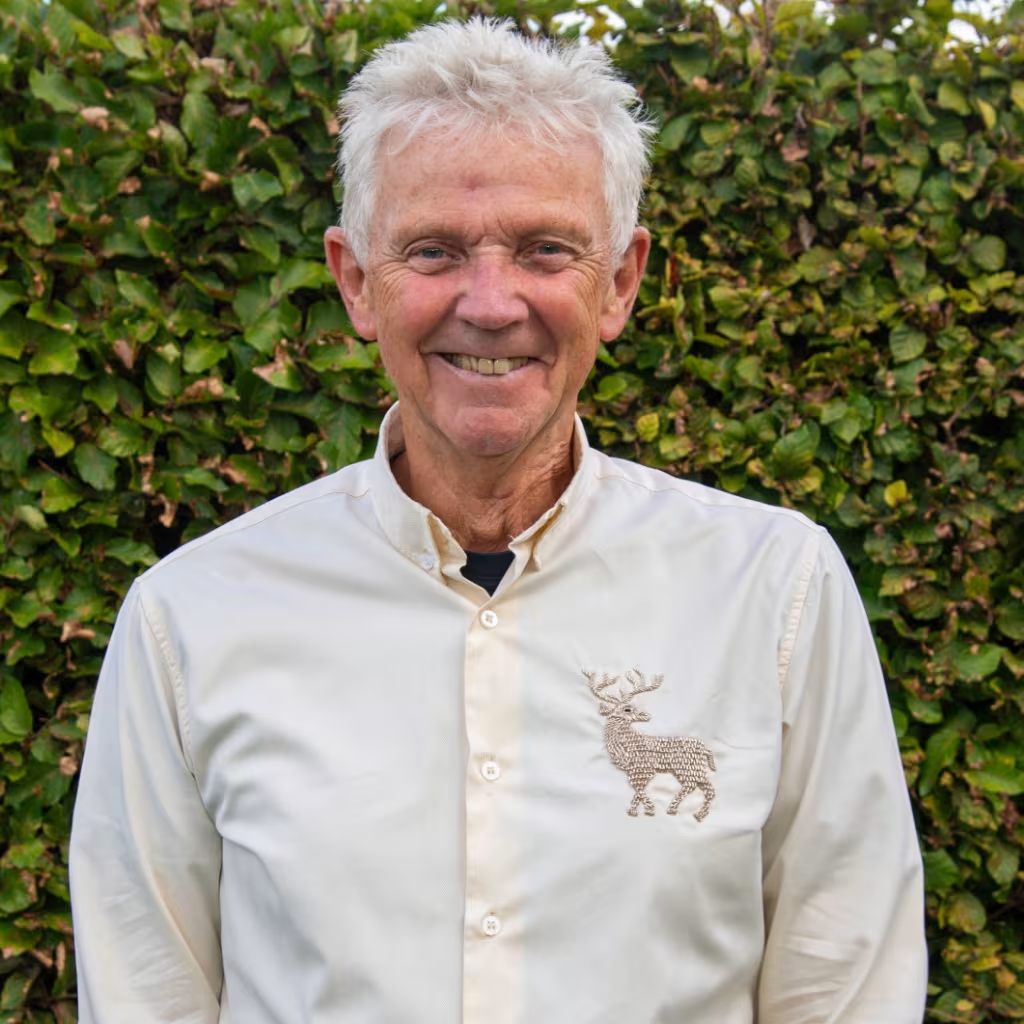
The Courage to Stand Up and Stand Out
Outstanding Global is built around a powerful proposition: leaders need to stand up for who they are, stand out for what they believe in, and lead with greater courage, clarity and authenticity. A bigger role changes the expectations placed on a leader. A rapidly evolving organisation requires different behaviours from those that worked previously. A misaligned team may need more than another strategy document. A company seeking cultural change cannot necessarily achieve it through statements of intent alone.
Leadership transformation occurs when the internal shift begins to influence external behaviour. This means helping leaders understand not simply what they should do, but why they may be holding themselves back. This distinction changes the nature of development. Instead of asking leaders to acquire another collection of competencies, it invites them to examine their identity, values, assumptions and aspirations.
- What makes them extraordinary?
- What do they genuinely care about?
- What are they prepared to stand for?
- And what would become possible if they expressed those convictions more fully?
Such questions are uncomfortable precisely because they move beyond professional technique. They ask leaders to consider the person behind the title.
A Career Defined by Purpose
His leadership philosophy cannot be separated from the wider trajectory of his career.
His professional life has extended well beyond boardrooms and executive-development programmes. In the 1980s, he founded Northern Lights Trust, an organisation established to support people affected by HIV and AIDS. The organisation developed counselling, workshops, information resources and support networks, working internationally across Europe, the United States and Australasia. He later founded and led Green Light Trust, an environmental charity focused on bringing people and nature together.
Through that work, Nigel became involved in rainforest conservation in Papua New Guinea, community-owned woodland projects in the United Kingdom, biodiversity, low-carbon alternatives and environmental education. The scale of some of these achievements is striking. Green Light Trust’s work included the conservation of approximately 2,000 square miles of rainforest in Papua New Guinea and the establishment of 62 community-owned woodlands across the UK, with more than five million trees planted through those efforts.
The projects also developed international partnerships involving communities in countries including Ghana, Poland and Sierra Leone. These experiences provide important context for understanding his approach to leadership. Purpose, in his career, has not been confined to a corporate mission statement. It has appeared in very different forms: responding to a public-health crisis, protecting ecosystems, developing communities and helping organisations become more conscious of how they operate. The common thread is agency.
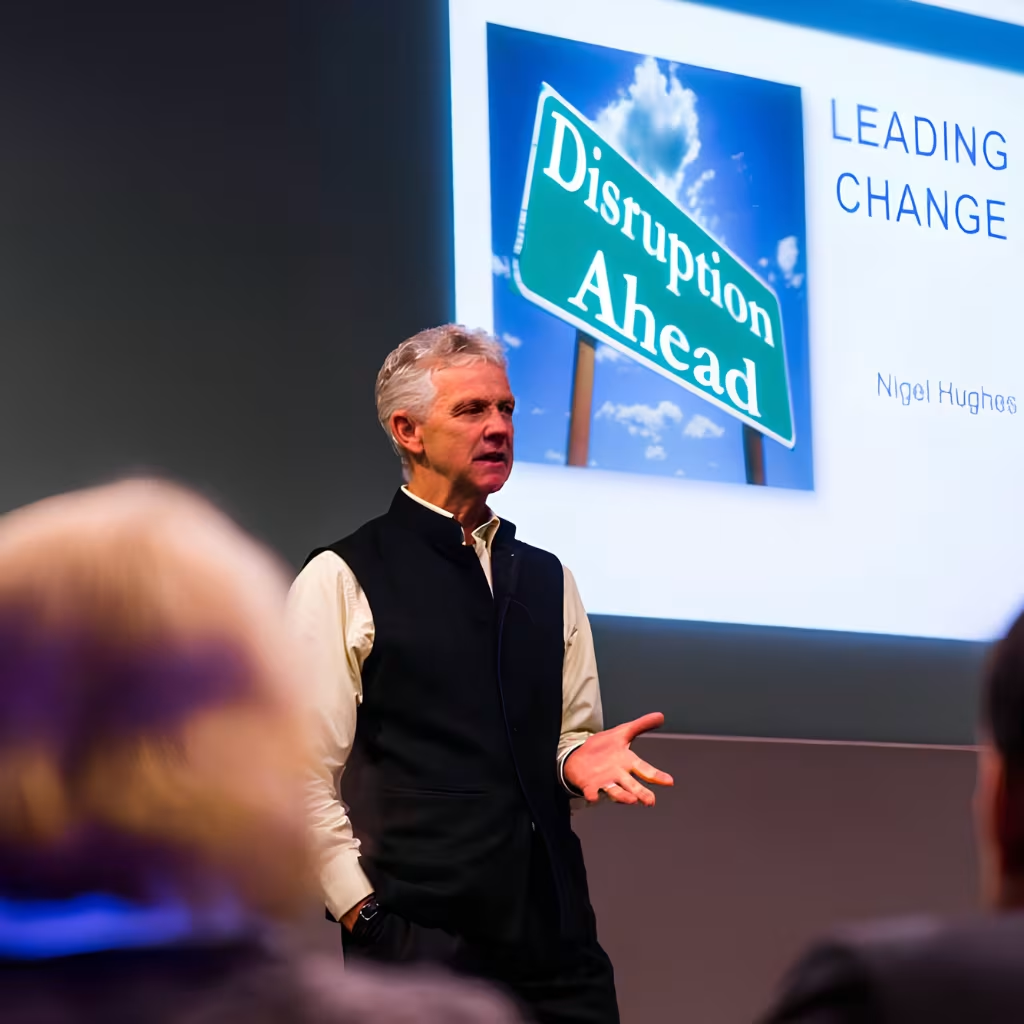
The Business Case for Human Leadership
There is an important commercial dimension to this philosophy. In complex organisations, leadership is increasingly less about simply issuing instructions and more about creating alignment. People need to understand where an organisation is going, why the destination matters and how their contribution connects with the wider purpose. This makes authenticity more than a personal-development concept.
A leader who communicates one set of values while behaving according to another creates friction. A culture that claims to encourage innovation but punishes every experiment sends a contradictory message. An organisation that talks about purpose without translating it into decisions risks creating disengagement rather than commitment. The challenge is therefore to bring greater coherence between intention and action. His experience with senior leaders has repeatedly placed him in this space.
At Capgemini, for example, he was involved in architecting and leading the Future Leaders Programme over seven years, supporting promising talent as they transitioned into leadership roles. The work addressed capability, commercial awareness and personal confidence, but the deeper objective was to help people make the psychological and behavioural transition into leadership. Elsewhere, his work with senior executives has focused on confidence, strategic thinking, self-awareness, team performance and the ability to communicate with greater impact.
The consistent principle is that leadership development has to reach beyond information. People rarely transform simply because they have been given more information. They transform when something changes in how they see themselves, how they interpret their circumstances and how they choose to act.
Open-Hearted, Conscious Leadership
Today, Outstanding Global describes its purpose as inspiring people to become “Open-Hearted Conscious Leaders.” The phrase captures another important aspect of Nigel’s thinking. Leadership is often associated with authority, decisiveness, and control. He introduces qualities that can sometimes be treated as secondary in conventional corporate environments: openness, humanity, self-awareness, and authenticity. Yet these qualities can become increasingly important as leadership becomes more relational.
Senior executives influence not only through formal authority but through the environment they create around themselves. Their behaviour shapes how people communicate, whether challenge is welcomed, whether ideas are voiced, and whether individuals feel able to contribute fully. Conscious leadership therefore requires awareness of impact.
A leader may intend to be decisive but be experienced as dismissive. They may believe they are giving people autonomy while inadvertently creating ambiguity. They may want to encourage openness while unconsciously signalling that difficult conversations are unwelcome. Transformation begins when leaders become sufficiently self-aware to recognise these gaps. That awareness does not make leadership softer. It can make it more precise. A conscious leader understands that every interaction communicates something. Every decision reinforces a culture. Every conversation either strengthens or weakens trust. Becoming more human is not a departure from effective leadership. It is part of becoming more effective.
From Experience to Expression
Perhaps the most compelling idea within his philosophy is the movement from experience to expression. Experience gives leaders knowledge. Years in a profession provide perspective, judgement and pattern recognition. But experience alone does not guarantee that those qualities will be visible or influential. Expression is what allows experience to create impact. It is the ability to articulate a vision with conviction. To challenge assumptions when necessary. To have a difficult conversation rather than avoid it. To communicate an idea in a way that moves people. To make a decision that reflects genuine values rather than simply following convention.
This becomes particularly significant for leaders who have spent years building credibility. The very behaviours that helped them reach senior positions can become limitations if they are never reconsidered. Caution can become excessive conservatism. Professionalism can become emotional distance. Consensus-building can become avoidance of difficult decisions. Expertise can become reluctance to listen. Transformation in his model is not about rejecting the past. It is about understanding what the next version of leadership requires.
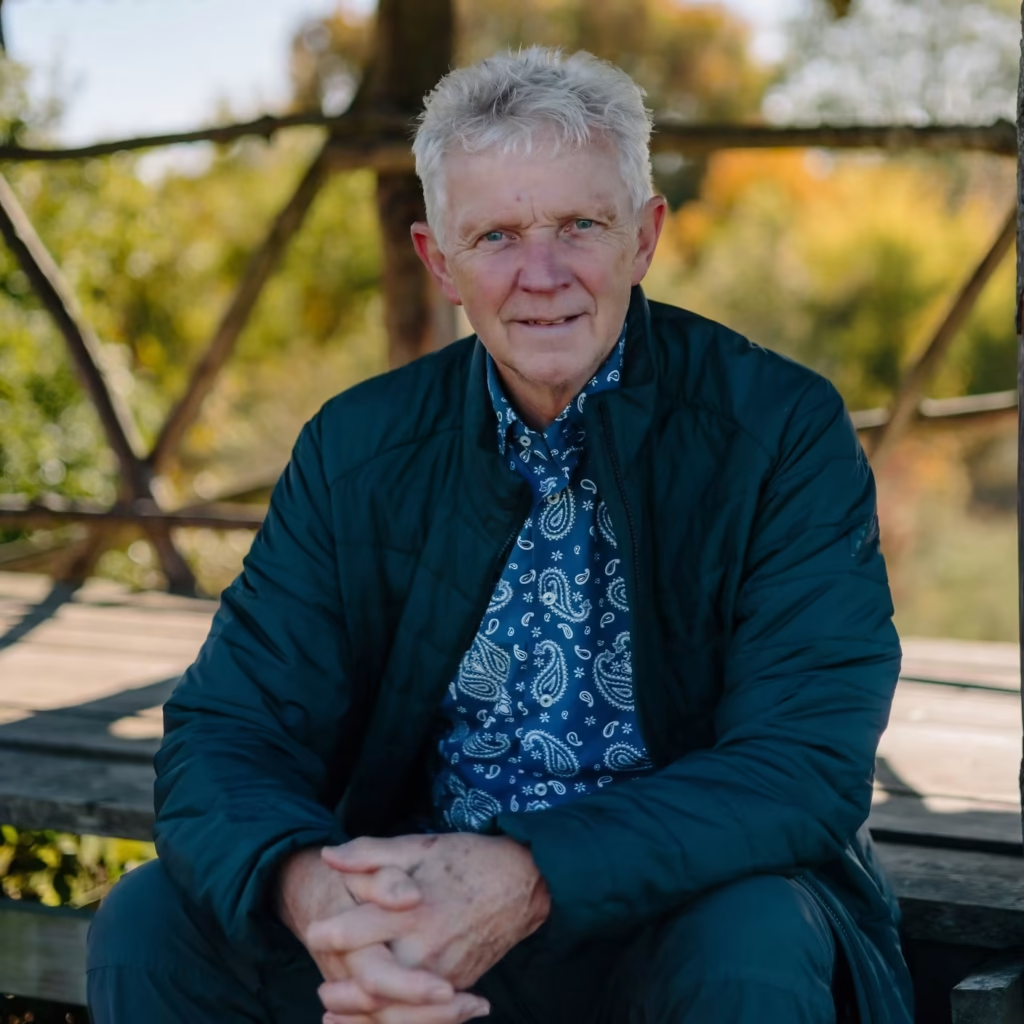
A Different Kind of Leadership Development
The idea that leadership transformation does not begin with a training manual is central to Outstanding Global. Nigel’s unconventional background gives him a perspective that is difficult to replicate through traditional executive-development models. His experience spans performance, business leadership, coaching, sustainability, social enterprise, and organisational development. That breadth allows him to view leadership through multiple lenses. The performer understands presence. The executive coach understands behaviour. The entrepreneur understands responsibility and execution.
The environmental leader understands systems and long-term impact. The social-impact founder understands purpose and human resilience. Together, these experiences inform a philosophy in which leadership is treated as something lived rather than simply learned. This is also why his work focuses on moments of change. Transformation becomes particularly relevant when the old way of operating no longer fits the demands of the future. A promotion, restructuring, cultural shift, strategic transition, or new organisational ambition can expose assumptions that previously remained invisible.
Such moments create uncertainty, but they also create possibility. They provide an opportunity to ask not simply, “How do we do this better?” but “Who do we need to become to do this differently?”
Building a More Conscious Future
The evolution of leadership is ultimately inseparable from the evolution of organisations. Businesses are navigating increasingly complex expectations from employees, customers, communities, investors and wider society. Leaders are required to think commercially while also considering culture, sustainability, social impact and long-term responsibility. This does not make leadership easier. It makes the quality of leadership more consequential.
The answer is not to produce executives who are better at meeting the expectations of leadership. It is to help create leaders who understand themselves well enough to lead with greater clarity and conviction. That philosophy explains the evolution from his earlier work in leadership development to the creation of Outstanding Global.
The organisation represents the convergence of the experiences that have defined his career: performance and presence, business and purpose, individual development and organisational change. It also reflects a belief that leadership should be both ambitious and human.
The Leader Behind the Leadership
Nigel’s career resists easy categorisation. He has moved between theatre and television, corporate boardrooms, executive coaching, environmental conservation, social enterprise and community development. His achievements range from working with global organisations to protecting vast areas of rainforest and establishing community woodlands. Yet the diversity of these experiences does not make his story fragmented. It makes it coherent. At the centre is a consistent belief in the possibility of transformation.
People can move from uncertainty to confidence. Organisations can move from intention to action. Communities can move from dependence to ownership. Leaders can move from capability to expression. And perhaps most importantly, experienced leaders can rediscover the parts of themselves that professional success may have taught them to hold back. That is the space Outstanding Global occupies. It is about creating the conditions in which leaders can become more fully themselves and, through that authenticity, create greater impact around them. In a business environment increasingly defined by complexity, change and competing demands, that may be one of leadership’s most important challenges.
The future will not necessarily belong to the leaders who know the most techniques. It will belong to those capable of bringing their knowledge, values, courage and humanity into the same room and having the presence to act on what matters. That is where leadership transformation begins.