
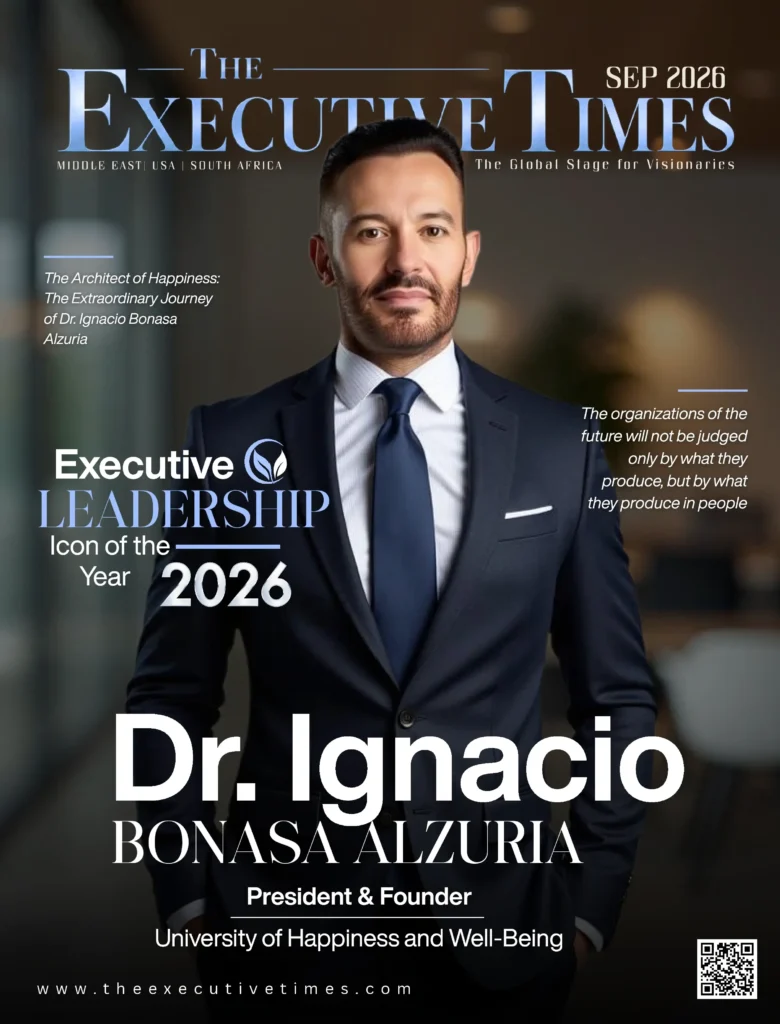
Cover Story -
Dr. Ignacio Bonasa Alzuria
President & Founder of University of Happiness and Well-Being
"Executive Leadership Icon of the Year 2026"
The Architect of Happiness: The Extraordinary Journey of Dr. Ignacio Bonasa Alzuria
President & Founder, University of Happiness and Well-Being
The organizations of the future can be understood not only through what they produce, but also through the impact they have on people.
A Career That Refused to Choose Sides
Dedicated to a lifelong pursuit, a certain class of leader works unceasingly to bring together two realms society insists on keeping separate: the world of numbers and the world of the human heart. Dr. Ignacio Bonasa Alzuria is that leader. For more than two decades, his professional life has moved fluidly between banking and emotion, boardrooms and classrooms, spreadsheets and soul, until the boundary between “hard” performance and “soft” humanity all but disappeared.
Today, he is the President & Founder of the University of Happiness and Well-Being, an educational initiative established in Mexico with an ambition to make happiness a rigorous subject of study, worthy of the same seriousness that finance, engineering, or medicine command. But to understand how a former banking executive became one of the most recognized voices in humanistic leadership across Europe and Latin America, one has to go back to where his story actually begins, not with happiness, but with numbers.
Chapter One: Before Happiness, There Was Performance
Long before Ignacio Bonasa spoke publicly about purpose, soul, or well-being, he was fluent in an entirely different vocabulary, one built on targets, risk, accountability, and power. His professional foundations were laid in the demanding world of Spanish banking, where he rose through senior leadership positions across institutions including Banco Exterior de España, Argentaria, and the BBVA environment, later extending his executive experience internationally into Portugal and eventually taking on top management responsibilities at Caja Rural de Aragón (Cajalón).
These were not easy years of theory and abstraction. They were years of real decisions with real consequences, of hierarchies that mattered and performance that was visible to everyone in the room. This experience became his first school of leadership, one that no leadership seminar or management textbook could fully replicate.
What set Bonasa apart, even then, was that he never treated this chapter as something to escape from. He continues to regard it as the bedrock of everything that followed. Finance taught him rigor. Executive life taught him something more uncomfortable: authority is never neutral. A leader shapes the emotional climate of a team even while believing he is simply managing numbers on a page.
Over time, his experience in management led him to examine not only how organizations perform, but also what their practices leave behind in the people who work within them.
That question would become the hinge on which his entire career would eventually turn.
The Quiet Rupture That Wasn’t a Rupture
Every transformative career has a turning point, and for Bonasa it arrived not as a dramatic exit but as a gradual widening of vision. Having seen organizations from the inside, including their budgets, reporting lines, and visible architecture, he grew curious about the invisible one: trust, fear, motivation, identity, belonging, and meaning. These factors rarely appear on a balance sheet, yet they can quietly determine whether an organization thrives or slowly hollows itself out.
This curiosity led him to found Liderarte, a platform dedicated to developing people and organizations through methods that deliberately break from conventional corporate training. It was not a rejection of his banking years; it was an expansion of them. Through this work, he developed a philosophy that transformation rarely comes from information alone. People are more likely to change when an idea is experienced, felt, questioned, and integrated, rather than merely explained in a presentation.

When the Classroom Becomes a Stage
If there is one idea that has come to define Bonasa’s professional identity, it is the principle that art is not decoration in leadership development, but the method itself.
At Liderarte, theatre, music, storytelling, movement, and nature-based experiences are not entertainment breaks inserted between “serious” business sessions. They are the curriculum. The programme names alone read like a deliberate refusal to speak conventional corporate language: Resetéate, IAbility, Desayunarte, Naturalizarte, Caminarte, ARTEcoaching, Artelicidad, ARTalento, Liderazgo Broadway, Beatles for Management, ExplorArte, and El Líder Orquesta, among many others.
Behind the wordplay sits a consistent educational philosophy. A person is not simply a rational processor of content. Learning also happens through emotion, imagination, the body, and surprise. A leadership programme that ignores those dimensions risks transferring concepts without ever changing behaviour. Bonasa’s approach places experiential learning at the centre of leadership development, using artistic experiences to reach aspects of learning that conventional presentations may not fully address.
His broader philosophy challenges the longstanding divide between “hard” business outcomes and “soft” human capacities. He prefers the term Human Skills, encompassing listening, self-awareness, empathy, courage, adaptability, and the capacity to create meaning. In his framework, these are not accessories to good leadership. In an uncertain world, they are part of leadership’s operating system.
His educational approach is supported by proprietary frameworks such as the 4A Model, AxAxA, and the 3×1 methodology, developed to connect experiential learning, attitude, action, and human transformation.
The Reset Principle: Reinvention as a Discipline, Not a Departure
Central to Bonasa’s philosophy is the idea of the “reset,” a concept that is at once deeply personal and organizational. For Bonasa, resetting does not mean erasing one’s past. It means examining the beliefs, routines, and identities that once served us well but may now be quietly holding us back. Companies, he argues, fall into the same trap. They become imprisoned by the very habits that once made them successful.
His own biography illustrates this principle. The banker did not vanish when the educator emerged. The executive discipline remained fully intact, layered with a new vocabulary of creativity, emotion, and purpose. In this reading, reinvention is not escape. It is integration. This philosophy would eventually find its fullest expression not in a company, but in an institution.
Giving Happiness an Institution: The Birth of a University
In Mexico, Ignacio Bonasa established the University of Happiness and Well-Being (Universidad de la Felicidad y del Bienestar) as an international educational initiative dedicated to the scientific and humanistic study of happiness, integral well-being, conscious leadership, and human development.
As its President & Founder, Bonasa built the university around eight interconnected dimensions of well-being, spanning the body, thought, emotions, transcendence, social connection, professional life, financial well-being, and digital well-being. This architecture treats human flourishing not as a single soft skill, but as a multidimensional field of study and development. The university’s stated ambition is to foster an international ecosystem of knowledge, bringing together universities, companies, public institutions, and civil society.
The word “happiness” is often trivialized in public conversation, reduced to a slogan on an office poster. Bonasa’s philosophy argues for the opposite. Happiness and well-being merit serious study because they shape health, relationships, learning, engagement, leadership, and ultimately the sustainability of performance itself.
Within this framework, happiness is not permanent cheerfulness, nor is it an employer’s promise that work will always be pleasant. It is better understood as the creation of conditions in which people can develop, contribute, belong, recover from adversity, and connect their daily efforts to something meaningful.
Mexico was not chosen by accident. Bonasa sees Ibero-America as a region capable of building its own conversation about humanistic leadership, rather than simply importing management trends developed elsewhere. The university’s ambition is therefore as cultural as it is educational: an attempt to connect scientific evidence and methodology with a distinctly human understanding of how organizations, and the people inside them, actually function.

Leadership With Soul — Without Losing the Numbers
Few phrases capture Bonasa’s public philosophy as precisely as “leadership with soul.” It is a phrase that can sound poetic, even deliberately disruptive, inside a conventional business context. But Bonasa uses it as an integrative idea rather than a mystical one: leadership that combines self-awareness, ethical legitimacy, a genuinely human perspective, and purposeful action.
Crucially, “soul” does not exempt leaders from delivering results. His banking background makes that impossible to ignore. His argument instead is that how results are achieved matters enormously, and that organizations pay hidden, often invisible costs when short-term performance is purchased through fear, humiliation, incoherence, or chronic exhaustion.
His intellectual work, spanning doctoral-level study, articles, books, and international conference contributions, has consistently sought to connect disciplines that institutions typically keep in separate silos: leadership, psychology, organizational transformation, education, well-being, and business.
His academic background combines a degree in Law, an MBA from ICADE, and executive management education at IESE, together with completed doctoral qualifications, postdoctoral studies, and international honorary academic distinctions. His postdoctoral work includes Administrative Sciences and Senior Management, Philosophy and Multidisciplinary Scientific Research, and Organizational and Occupational Well-Being.
He has also received numerous Doctor Honoris Causa distinctions from international academic institutions, recognising his contributions to leadership, education, human development, and well-being. In addition, he is a Full Member (Académico Numerario) of the Royal European Academy of Doctors (RAED) and has been inducted into the Academy of Sciences, Engineering and Humanities of Lanzarote.
These recognitions accompany his growing international academic profile.
Transform With Soul: A Philosophy for the Age of Machines
His most recent formulation, “Transform with Soul,” compresses his entire trajectory into three words. Transformation, in his view, is necessary and unavoidable. Soul is the safeguard that keeps it human. The idea suggests that innovation, restructuring, technology, and growth should be evaluated not only for efficiency, but also for their effects on the human beings living inside organizations.
This matters with particular urgency in the age of artificial intelligence. As machines grow ever better at processing, predicting, and generating, Bonasa’s philosophy places increasing value on the human capacities that organizations must continue to cultivate: judgment, empathy, conscience, trust, imagination, and meaning.
From this perspective, technological progress should expand human capabilities without diminishing humanity. The central leadership challenge is not simply to determine what AI can do, but to decide which human qualities should remain at the heart of organizational life as automation makes greater efficiency possible.
A Voice, a Movement, and a Growing Institutional Footprint
Beyond the university, Bonasa’s influence extends across a network of leadership, well-being, and social-impact organisations. His institutional roles include leadership responsibilities associated with the European Association of Organizations with Soul, the European Wellness Association, the International Association “Dale la Vuelta a la Tortilla,” and the Parliament of Latin American Leaders. The latter is focused on civic leadership, international cooperation, and human development. He also serves as Chancellor for Europe of the International Official College of Doctors.
These organisations reflect themes that recur throughout his work: humanistic leadership, holistic well-being, civic engagement, and the development of people and communities. The movement “Dale la Vuelta a la Tortilla” is associated with the idea of turning pain into strength, offering a social perspective on resilience and personal transformation.
His methodologies, including Learning Through Art, the 4A Model (Aprendizaje, Actitud, Alma, Acción — Learning, Attitude, Soul, Action), AxAxA, and the 3×1 methodology, have been used within his broader educational and leadership approach. Through lectures, corporate transformation programmes, and academic collaborations, his work has reached audiences across Europe, Latin America, the Middle East, and Africa.
He is the author of more than 200 articles and an extensive body of academic, scientific, and professional publications. His literary work includes La Receta del Bienestar: Una Fórmula para Ser Más Feliz, alongside other books addressing humanistic leadership, organisational transformation, happiness, and well-being. His contributions have also received recognition from the wider business and communications world. Bonasa has received several international distinctions, including The BIZZ, FLUXX, PRIME, and IMPACT awards, reflecting the reach of his professional work across sectors and borders.

The Ideas That Define Him
Happiness. Well-Being. Purpose. Human Skills. Learning Through Art. Resetting. Leadership with soul. These themes recur throughout Bonasa’s work not by coincidence, but by design. He is attempting to build an entire ecosystem rather than a single programme. The common denominator, always, is the person.
That focus has pulled him into conversations that spill well beyond conventional management: health, education, culture, ethics, social impact, and the future of work itself. His professional identity resists being compressed into a single conventional title. The description “architect of happiness” captures an intention rather than a job description.
The metaphor also reflects a central idea in his approach to leadership: while no design can guarantee every outcome, thoughtful structures and environments can make better human possibilities more likely.
The metaphor carries its own standard, and Bonasa seems acutely aware of it. Architecture requires foundations. If happiness is to be more than branding, it needs evidence, methods, measurement, and institutional credibility. These principles are central to the educational and research ambitions associated with the University of Happiness and Well-Being.
In His Own Words: Credibility, Purpose, and the Cost of Meaning
Bonasa’s perspective on leadership places credibility at the centre of influence. In this view, formal positions may secure obedience, but lasting followership depends on consistency between what leaders say, what they do, what they tolerate, and how they behave when things go wrong.
He also distinguishes meaningful organizational purpose from corporate messaging. Purpose, in his framework, becomes credible when it influences decisions, incentives, priorities, and choices. An organization that claims to value people while rewarding harmful behaviour for short-term results reveals its actual priorities through its actions.
Transformation remains another defining theme in his work. Bonasa’s approach centres on the moment when a person or organization begins to see a situation differently and recognises that another way forward is possible. Such moments can emerge in a boardroom, classroom, theatre, or conversation. His work seeks to create the conditions in which those shifts in perspective can take place.
Beyond the Title: Designing a More Human Future
There is an obvious temptation, when exploring the journey of a figure like Ignacio Bonasa, to focus purely on accumulation: executive posts, academic credentials, honorary distinctions, publications, institutions, international engagements, and a catalogue of programmes whose names resist conventional corporate language. But the more revealing story lies in the thread connecting all of it.
His career can be read as a steady movement from managing performance to investigating the human conditions that make performance worth sustaining in the first place. Banking gave him scale and discipline. Entrepreneurship gave him the freedom to experiment. Art gave him a language for emotion and lived experience. Academic inquiry gave him frameworks. And the University of Happiness and Well-Being gave his central idea an institutional form.
That idea is both ambitious and, importantly, testable. Happiness belongs in serious conversations about leadership, not as a promise of permanent satisfaction, and not as an excuse to avoid difficult decisions, but as a way of asking better questions about how institutions shape the people who live inside them every day.
In an era fascinated by artificial intelligence, acceleration, and relentless productivity, Ignacio Bonasa’s work places emphasis on the deliberate cultivation of what remains irreducibly human. His vocabulary — soul, happiness, purpose, and art — may sound unusual in a management context. That, perhaps, is exactly the point. He is trying to widen the language of leadership without abandoning its responsibility for results.
The strongest version of his proposition is not that every company must become happy. It is that every organization is already designing a human experience, intentionally or not, and that leadership ultimately influences whether that experience produces fear or trust, exhaustion or growth, indifference or meaning.
The architect of happiness does not promise a perfect life. Instead, his work encourages the idea that the places where we work, learn, and lead can be designed more consciously and more humanely. For Bonasa, transformation is no longer simply a business objective. It has become a personal, organizational, and educational responsibility, one that his continuing work seeks to advance across institutions, classrooms, publications, and international stages. The guiding principle remains consistent: put the person back at the centre, connect results with purpose, and transform with soul.