
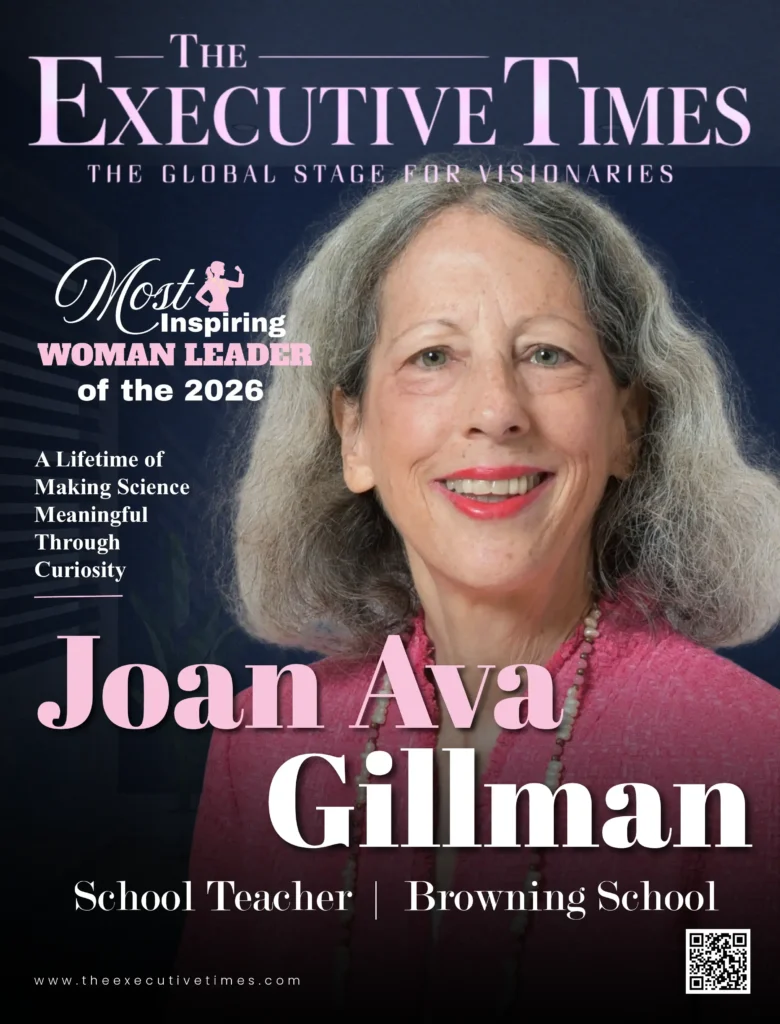
Cover Story -
Joan Gillman
School Teacher at Browning School
"Most Inspiring Woman Leader of the 2026"
A Lifetime of Making Science Meaningful Through Curiosity
For Joan Ava Gillman, science has never been limited to textbooks and classroom instruction. It is about asking questions, experimenting with ideas and discovering how the world works. This belief has shaped more than 44 years of her career as an educator, influencing how she teaches, develops curricula and encourages students to explore their potential.
Currently a Lower School Science Teacher at The Browning School in New York City, Gillman has built her career around hands-on learning, inclusive education and environmental awareness. Her professional journey spans several schools across New York and New Jersey, alongside contributions to educational publications, science organisations and international initiatives.
Where Curiosity Began
Gillman’s interest in science developed during childhood. She was fascinated by snowfall, often measuring its accumulation, checking temperatures and observing weather conditions. At home, she experimented with powders and liquids, built shoebox robots with her older brother and constructed an imaginary town using building sets.
Her interest in teaching emerged through community service during high school. She taught elementary students to play the recorder, helped children with mathematics and organised playground activities that ensured everyone could participate. She also taught swimming to children with special needs and substituted as a ballet teacher.
These experiences shaped an important principle that continues to guide her: every child deserves an opportunity to learn, participate and succeed.
Gillman’s educational journey included a Bachelor of Arts in Education, completed summa cum laude at Felician College, now Felician University, in 1980, followed by a Master of Arts in Education from New York University in 1982.
A particularly influential experience came during her student-teaching placement at P.S. 47, a junior high school for deaf students. There, she observed students learning electronics by constructing a miniature amusement park with working rides and attractions. The experience demonstrated how practical, visual and tactile activities could make complex scientific concepts accessible.
Hands-on learning became a defining feature of her teaching philosophy.
A Career Across New York and New Jersey
Gillman began teaching in 1982 at St. Angela Merici School in the Bronx as a fifth-grade teacher. Her career subsequently included positions at Joytown Kent Elementary School, the Bede School in Englewood, the Professional Children’s School in New York, Anna C. Scott Elementary School in Leonia and Yeshivat Noam in Paramus.
At the Professional Children’s School, she spent two decades teaching academic subjects in grades four and five, as well as mathematics and science in sixth grade. She also managed the middle school’s Student Government programme.
In 2008, she joined the Calhoun School in New York City, where she taught fifth- and sixth-grade science for ten years. She moved to The Browning School in 2018, where she currently teaches science across kindergarten, second and fourth grades and leads the K-8 Green Team.
Across these institutions, her approach has remained consistent: students have different learning needs, and education must adapt accordingly. She rejects one-size-fits-all teaching in favour of methods that help each child understand concepts in their own way.
Making Science Practical and Engaging
Gillman’s classroom activities encourage students to learn through experimentation rather than memorisation.
Her fourth-grade Straw Rocket unit asks students to build rockets using straws, clay nose cones and fins. They test different launch angles, measure flight distances and analyse their results. When an initial attempt fails, students are encouraged to make adjustments and try again.
For second-grade engineering, she uses a storytelling exercise involving a family of four elephants. Students must design and build a bridge from recycled materials and craft supplies capable of supporting two adult elephants and two calves. The activity combines science, engineering, mathematics and art in a practical challenge.
She also makes herself available before school to help students who need additional support.
Environmental Awareness Beyond the Classroom
At The Browning School, Gillman leads the student-run Green Team, an initiative focused on environmental responsibility and community participation.
Students contribute a weekly Green Action of the Week, organise cleanups in Central Park, participate in Biodiversity Week challenges, invite guest speakers and conduct fundraisers for causes including hurricane relief.
Her aim is to help students develop compassion for living things and understand their ability to become positive changemakers. Lessons on global water scarcity have also encouraged students to join the initiative, demonstrating how classroom learning can inspire action beyond school.
Navigating Challenges Through Education
Gillman’s career has included moments that tested her adaptability and understanding of students’ needs.
During her first year of teaching in the South Bronx, she managed a fifth-grade classroom with six different reading levels, with student abilities ranging from second-grade to tenth-grade levels.
In 1986, the Challenger space shuttle disaster interrupted a science lesson with sixth-grade students who had been following the mission closely. Gillman had to help them understand the tragedy while responding carefully to their questions and concerns. The experience reinforced her understanding of the wider responsibility teachers carry in students’ lives.
During the COVID-19 pandemic, she adapted practical science lessons for remote learning. She sent students and parents lists of household materials to prepare simple kitchen laboratories, then conducted live online demonstrations and guided families through experiments.
Her move to The Browning School also brought a new challenge: teaching second-grade students alongside older learners. She embraced the transition and continues to enjoy working across different age groups.
Music, Writing and Professional Contributions
Outside teaching, Gillman is a classically trained pianist and violinist. She performs with the Bergen Philharmonic Orchestra, the North Jersey Symphony and The August Symphony Orchestra. At least four times a year, she also volunteers at nursing facilities, performing music for residents.
Her contributions to science education include articles published in the STANYS Bulletin and Science and Children, the latter associated with the National Science Teaching Association.
Her curriculum, Straw Rockets Are Out of This World, was published in Science and Children in 2013 and reprinted in the 2016 book Bringing STEM to the Elementary Classroom. She also contributed materials to Corwin Publishers’ What Teachers Want to Know About Teaching Climate Change.
In 2011, her curriculum on the Great Japanese Earthquake and Tsunami received a grant from Cornell University’s East Asian International Studies programme. She was also recruited as a teacher ambassador for NASA’s Mars Atmosphere and Volatile Evolution (MAVEN) mission.
Gillman has served as an elementary-level Subject Area Representative for the Science Teachers Association of New York State in New York City. Her work has included conference workshops, leadership meetings and speaker recruitment. She has also presented at events organised by NSTA, STANYS, the Science Council of New York City, NYSAIS Diversity Symposium and STEMTeachersNYC, and helped plan the SCONYC conference in 2024.
Her professional development includes certification as a National Geographic educator in 2019 and completion of the Modern Classroom Project’s five-week course in 2022. She is also an active member of SEEDS, Science Educators for Equity, Diversity, and Social Justice.
Recognition and International Engagement
Gillman’s work has received recognition from educational institutions and professional organisations. In 2017, the Calhoun School presented her with its Urhy/Thompson Award.
Marquis Who’s Who has recognised her among its Top Educators and Who’s Who of Professional Women, and presented her with a Lifetime Achievement Award. She has also received recognition from Kappa Delta Pi as a Legacy Member.
Her honours include the CXO Time Award for Most Inspiring Educator in Science Education in 2024, recognition among CXO Time’s Top 10 Leaders Shaping the Future and CIO Views Magazine’s Top 10 Empowering Women Leaders of the Year. In 2025, The Executive Lens included her among its Top 5 Women to Know, while MSN News featured her in “5 Female Leaders Who Went from Vision to Victory.”
The International Association of Top Professionals named her Top Educator of 2025. In 2026, it recognised her as Top Educator of the Decade, included her among its Top 50 Fearless Leaders and Top 25 Global Impact Leaders, and named her Woman of the Year.
In early 2026, she joined the Forttuna Education Council’s Global Advisory Board. In March 2026, Ms. Gillman was appointed as a United Nations Representative to the AWWG at the United Nations Economic and Social Council (ECOSOC). Regarding the appointment, she said it “is both a privilege and a responsibility. In this role, I look forward to contributing meaningfully to global dialogue, policy advocacy, and multi-stakeholder collaboration aligned with the United Nations Sustainable Development Goals (SDGs), particularly in areas of sustainable development, inclusive growth, and international cooperation.” She continued: “I am grateful for the trust placed in me and look forward to working alongside global leaders, policymakers, civil society organizations, and fellow representatives to support initiatives that create measurable, long-term impact. Thank you to everyone who has supported this journey. I remain committed to service, collaboration, and advancing solutions that contribute to a more sustainable and equitable future.”
Continuing the Journey
The Browning School’s guiding values of Curiosity, Honesty, Dignity and Purpose align closely with Gillman’s educational philosophy. Since the school began implementing the Next Generation Science Standards in summer 2024, she has worked with colleagues to update curricula accordingly. This past summer, she spent nearly 35 hours revamping the kindergarten and fourth-grade curricula so that they would be NSTA and Next Generation Science Standards aligned.
As she approaches 50 years in teaching, Gillman has embarked on another professional transition. She now focuses exclusively on the lower school and has added kindergarten to her teaching responsibilities for the first time, a change that has gone very well so far.
Her vision for education centres on interdisciplinary learning, where students connect different subjects rather than studying them in isolation. She also encourages aspiring educators to continue learning, maintain their sense of humour and seek support from colleagues when needed.
Joan Ava Gillman’s career is reflected in decades of teaching, curriculum development, professional contributions and international recognition. More importantly, it is visible in the students she has encouraged to experiment, question, build and discover.
Her work continues to demonstrate that curiosity, when supported by patience, creativity and inclusion, can shape how children understand the world and their place within it.