
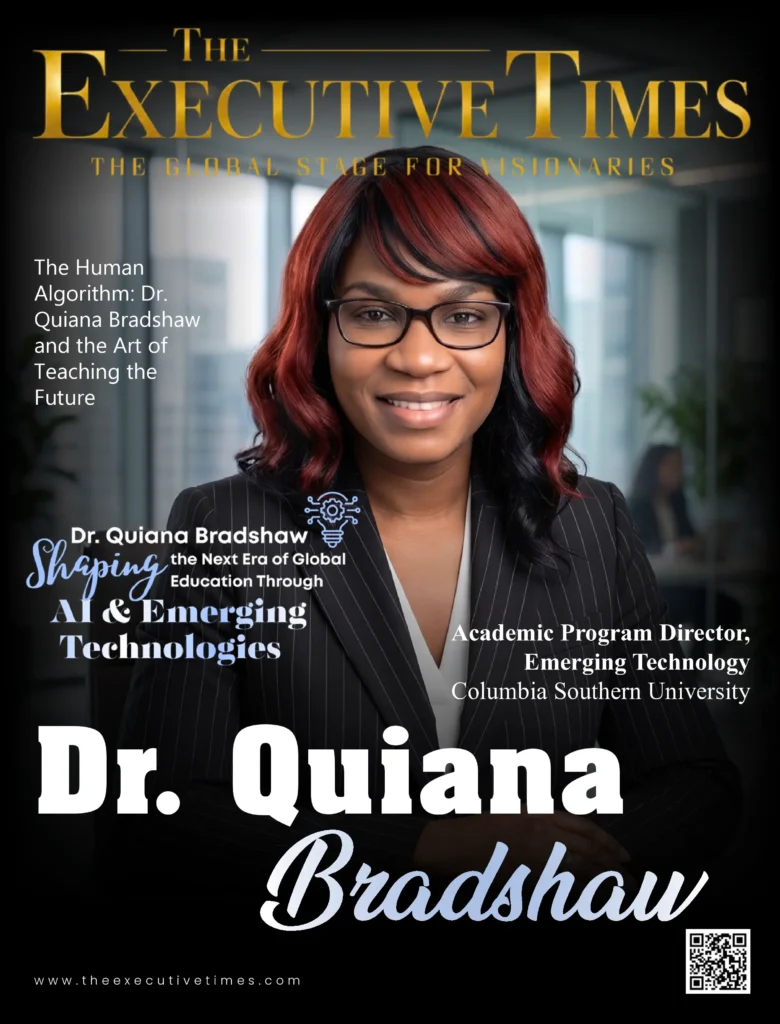
Cover Story -
Dr. Quiana Bradshaw
Academic Program Director, Emerging Technology at Columbia Southern University
"Shaping the Next Era of Global Education Through AI & Emerging Technologies"
A Glowing Screen in West Philadelphia
In 1982, a young girl in West Philadelphia sat in front of a television while a man was pulled into a computer and forced to fight for his life on a glowing grid. For most viewers, Tron was a spectacle. For Quiana Bradshaw it was a doorway.
The person who opened it was her father. By day he was an executive chef, a profession built on timing, precision and relentless standards. By night he studied software engineering, and his textbooks sat around the house like artifacts from a country she hadn’t yet visited. She remembers wondering what happened behind the screen, what invisible machinery turned instructions into pictures and decisions. Her older brother, who worked at IBM, made the idea feel less like a fantasy and more like a career someone in her family could actually have.
There was no master plan. Nobody sat her down and said she would one day earn a doctorate in computer science, lead an academic program devoted to emerging technology, or be invited into conversations about the future of artificial intelligence. What she had was curiosity and a household where learning was treated as ordinary. A father who worked a demanding kitchen job and still chased a second profession taught her something no lecture could, that ambition does not require ideal conditions.
Years later, she would trace a clean line from that child to the woman she is now. The through thread was the stubborn belief that you should understand how things work, and then help other people understand too.
The Tutor Who Found Her Calling
Many technologists discover early in life that they love machines. Far fewer discover, as Dr. Bradshaw did, that what truly inspires them is the moment a person realizes what they are capable of.
As an undergraduate in the mid-2000s, Quiana studied information technology and business administration at Colorado Technical University, exploring the familiar paths available to an aspiring technologist: help desk work, technical support, and the hands-on challenges of the industry. But an unexpected opportunity began to change her direction. She started tutoring her classmates.
There, she discovered something more meaningful than solving a technical problem. She witnessed the transformation that happens when confusion gives way to understanding, when uncertainty becomes confidence, and when someone who once believed they couldn’t suddenly realize they can. That moment gave her a sense of purpose that debugging a system never had. She wasn’t simply helping people learn technology; she was helping them see their own potential.
That realization reshaped her priorities. She still loved technology, but she had discovered a deeper calling: developing people, not simply implementing systems. It was a subtle shift in perspective, but one that would come to define nearly every decision that followed.
Quiana continued to pursue her education with remarkable determination, building an academic foundation that reflected both her technical interests and her growing commitment to leadership and human development. She pursued studies in Higher Education and College Administration Leadership, while also completing a dual MBA path, earning an Executive MBA in 2007 and an MBA in Healthcare Management in 2008. She went on to earn a master’s degree in information technology from the Florida Institute of Technology, where her academic excellence was recognized with an Outstanding Student Award in IT. Her journey culminated in a doctorate in Computer Science, specializing in Emerging Media.
Yet, for Quiana, these degrees were never simply credentials to display or milestones to collect. Each represented another tool, another perspective, and another opportunity to become the kind of educator and leader she envisioned. She wasn’t just preparing for the next position or professional achievement. She was preparing for a lifetime of opening doors for others, cultivating talent, and helping people discover possibilities they may never have imagined for themselves.
Her student years were also busy in ways a transcript doesn’t show. She mentored fellow students and served as a university ambassador. She joined clubs spanning accounting, writing, project management, travel and books. She was, in short, someone who collected communities as readily as credits
A Career Built One Classroom at a Time
Bradshaw’s path into higher education did not run through a single prestigious door. It was built patiently, from the ground up, across many institutions and many kinds of students.
Her working life began in the practical world. She supported customers through AT&T’s DSL help lines, working with troubleshooting scripts, ticketing systems and the daily pressure of high call volumes. She later worked help desk roles for remote support companies and did seasonal tech support for a tax preparation service. Alongside those jobs she served as secretary treasurer of a hospital foundation in Goldsboro, North Carolina, where she helped plan fundraising events and sat in on quarterly board reviews of budgets and spending, all in service of improving life for people with intellectual disabilities. Few future professors can say they learned governance and customer empathy in the same decade.
Meanwhile, the teaching began. From 2008 she taught online, first health science and healthcare policy courses, then information technology and computer science. Over the following years her name appeared on rosters at an astonishing range of schools. Kaplan University, Florida Institute of Technology, Southern New Hampshire University, Grantham University, Wayne Community College, Florida State College at Jacksonville, the University of the People, the University of the Cumberlands, Purdue Global, Thomas University and others. At several she became more than an instructor. She served as course lead and subject matter expert, which meant deciding whether a student’s life experience truly equalled college level learning and shaping the curriculum others would teach.
Faculty honors followed. Influential Women platform showcased that she has received faculty awards from both Purdue and Kaplan, also noting her career began in technical support and programming roles, including help desk and programming work at AT&T, before she moved into academia as an adjunct, course lead and lead in data science and AI.
From 2018 she spent seven years at Campbellsville University as lead faculty for data science and artificial intelligence, teaching subjects from AI and advanced programming languages to information systems security and disaster recovery planning. In 2021 she joined Judson University in Illinois as an assistant professor of computer science, where she teaches AI and human computer interaction, consults on a doctoral program’s course design and serves on the department’s committee. Judson’s faculty pages describe her as making a significant contribution to the field of game based learning.

The Winter the World Went Dark
Every life story has a chapter its subject would rather not have lived, and also would not trade. For Bradshaw, it began in February 2011.
She was in the middle of her doctoral program when her blood sugar collapsed into a diabetic coma. She woke with a glucose reading of 1,100, a number that signals how close the danger was. And when she woke, she could not see.
Consider what that moment meant for a woman whose entire life was organized around reading, coding, researching and building. Her eyes were the instrument of her work, and they had gone dark. She describes it as profoundly humbling, a moment when everything she had assumed about her future had to be reconsidered from scratch.
What carried her through, she says, was a triangle of support. Her faith in Yahuah gave her the language of a second chance. Her husband and her sisters, Leah and Paula, surrounded her through the frightening weeks, and her best friend, Susanne Schepe, stood beside her as well. Slowly her vision returned, and with it the question of what to do with the life she had been handed back.
She chose to go back to work on the doctorate. But the experience had changed what the work was for. Before the coma, she says, she had been focused on goals. Afterward she understood that knowledge earns its worth only when it makes someone else’s life better. She also came away with a different understanding of leadership. People carry battles that nobody around them can see, she learned, and a good teacher or manager should assume that behind a missed deadline there may be something heavy. That empathy now shapes how she mentors faculty and treats students.
A Dissertation, Two Babies and a Chorus of Doubt
The road to her doctorate, however, was not without extraordinary challenges. While pursuing her Doctor of Computer Science, Quiana experienced a life-altering medical crisis. After falling into a diabetic coma, she was left temporarily blind and had to take a medical leave of absence from her doctoral program. What could have marked the end of her academic journey became an unexpected chapter in her determination to finish what she had begun.
She would eventually return to her studies, continuing to build both her family and her future. Her first daughter, Nicole, was born during her second year of the doctoral program. In March 2013, she welcomed her second daughter, Nadia. And then came a milestone that brought years of perseverance, sacrifice, and determination full circle.
When Nadia was just six months old, Quiana successfully defended her dissertation and earned the distinction she had worked so hard to achieve: Dr. Quiana Bradshaw.
Her journey to the doctorate was about far more than completing a degree. It was about confronting circumstances she never anticipated, finding her way forward after a devastating medical setback, and refusing to let a difficult chapter define the ending of her story. She emerged not only with a doctorate in Computer Science, but with a lived understanding of resilience, perseverance, and the power of refusing to give up on a dream.
The research she produced was as playful as it was rigorous. Her dissertation asked a question that sounds almost mischievous for a doctoral thesis. What can World of Warcraft and Minecraft teach us about designing learning games? She used two frameworks, the psychologist Mihaly Csikszentmihalyi’s model of flow and designer Jesse Schell’s Elemental Tetrad of aesthetics, mechanics, story and technology, to examine why commercial games hold people’s attention for hundreds of hours while educational games so often fail to. The core problem, as her abstract puts it, is that educational games rarely win popular acclaim and may bore the learners they are meant to serve.
Her degree, a Doctor of Computer Science with a concentration in emerging media, came with a successful defense that she still celebrates publicly. She also co-authored a paper surveying education and web technology, game based simulations, AI in knowledge management and holographic display research. In the years since, she has written about immersive learning, including a piece exploring how LEGO’s robotics tools and virtual worlds can make computing education tangible
QBetic: When the Problem Is Your Own
Some of the most meaningful innovations are born not in a laboratory, but in the moments when life presents us with challenges we cannot ignore. For Quiana, the inspiration behind QBetic came from living with diabetes while pursuing her doctorate. She understood firsthand that managing a chronic condition involves far more than monitoring numbers. It requires consistency, discipline, access to information, and the emotional energy to navigate a condition that never takes a day off.
She also recognized a troubling reality: information intended to empower people can sometimes become another source of frustration and overwhelm. Glucose readings accumulate, daily routines become difficult to maintain, and the responsibility of managing one’s health can feel like a full-time job. Rather than simply accepting those challenges, Quiana saw an opportunity to make a difference.
Drawing on her background in computer science and her lived experience with diabetes, she began developing a technology solution designed to make diabetes management more accessible and manageable. That vision became QBetic Technologies, a diabetes-focused application designed to help individuals monitor their glucose levels, better understand their health information, and take a more active role in their own care.
Quiana advanced the project through Institutional Review Board (IRB) approval during her doctoral studies, demonstrating a commitment to the ethical considerations, research standards, and participant protections essential to developing technology that intersects with people’s health and well-being. Her work reflected an understanding that innovation, particularly in healthcare, must be grounded in responsibility, trust, and respect for the people it is designed to serve.
QBetic has shaped her view of what technology is for. She treats it as a philosophy more than a product. Before building something, ask whether it solves a real problem, whether it improves the human experience, whether it is accessible, and whether its ethical consequences have been considered. Her ongoing interest in healthcare, and in how emerging technologies might expand access to health information and personalize support, grows directly from that first project.

Playing for Keeps: The Judge’s Table
Bradshaw’s affection for games is not casual. It has become a form of public service.
Since December 2015 she has served as a judge for the SIIA CODiE Awards, the annual software competition run by the Software & Information Industry Association and established in 1986. Her assignments have spanned education and game simulation, instructional technology and academic tools, and she has reviewed products from household names in educational publishing and learning platforms. Judging is unglamorous, unpaid, detailed work, because a good judge writes feedback a developer can use, not merely a score. It also keeps her close to what is actually reaching classrooms.
Since 2018 she has been a game judge and reviewer for the Serious Play Conference, which showcases games designed for purposes beyond entertainment, including healthcare. And in early 2026 she began volunteering with Women in Games, supporting research, awareness and representation for women in the gaming industry.
These threads form a pattern. A woman who once studied why games hold attention now helps decide which games deserve it, and she works to make sure the people who build them look more like the people who play them.
Leading the Program: Columbia Southern and the Workforce Question
In May 2025, after years in classrooms and faculty roles, Bradshaw stepped into a new kind of work as Academic Program Director for Emerging Technology at Columbia Southern University. The job moves her from teaching individual courses to shaping entire programs.
Her responsibilities include guiding faculty who teach technology and emerging technology subjects, planning curriculum, assessing outcomes and driving continuous improvement. She also recruits and mentors faculty, supports accreditation and academic quality, and works across departments so that programs match what employers actually need. Underneath it all is a question she keeps returning to. How does a university keep pace with a field that changes faster than a catalogue can be printed?
Her answer is to treat AI not as a threat to be managed but as a subject students must learn to question. She wants graduates who can go beyond using AI tools to think critically about them, who can build solutions and weigh ethical implications. She is especially driven by learners who don’t fit the traditional technology mold. Working professionals, adult students, career changers, and people who have never seen themselves represented in the field. Her message to them is deliberately welcoming. You do not need a conventional background to take part in innovation.
That conviction has a personal edge. A woman who spent her own student years tutoring peers, who taught for a decade at institutions serving working adults, knows exactly who is easiest to overlook, and she builds programs with them in mind.
An MIT Ambassador for the AI Era
In March 2026, a new chapter opened when she became an ambassador for AI Powered Women, an initiative anchored at MIT. The organization is a global leadership and workforce readiness platform focused on helping women build practical AI fluency alongside human centered leadership capacities. It was founded by Dr. Felicia Newhouse, and its programming runs through conferences, local chapters and learning experiences, and includes an ambassador program that invites women to help widen access.
For Bradshaw the role is a natural extension of everything before it. She promotes AI literacy through community engagement, connects educators, professionals and students with learning opportunities, and advocates for women in AI and emerging technology. She has also completed a certification in AI strategy and business through the University of Pennsylvania, one of 114 certifications she has earned so far, a reminder that someone who has earned a doctorate still treats learning as unfinished business.
Her message about the technology is notably calm. Don’t fear it, she tells audiences, but don’t treat it as magic either. Learn it, test it, question it, and take part in shaping it, because the future of AI should be decided by teachers, researchers, entrepreneurs, mothers and creative thinkers, not only by engineers. People, she insists, must remain at the center of innovation.

The Woman Behind the Title
For all the credentials, Bradshaw describes her foundations in simple terms. Faith, integrity, perseverance, compassion and continuous growth. Her relationship with Yahuah is the lens through which she weighs decisions, and she regards her abilities as carrying a responsibility to serve. Integrity, she says, is the one principle she refuses to bend, particularly in a field where algorithms increasingly influence real lives. Transparency, fairness and honest accountability, in her view, are not optional extras in AI development. They are the work.
At home she is a wife and a mother of three. She credits motherhood with teaching her patience, sacrifice and the discipline of leading by example, and she is clear that her daughters were part of her motivation as much as her responsibility. Professional recognition, she says, has never been the final measure. Her family reminds her why legacy matters.
Colleagues and readers who meet her professionally might also notice how widely her curiosity ranges. The same person who reviews healthcare games and judges education software also writes computer science textbook chapters, having contributed to two textbooks and revised others for the publisher Wisewire between 2024 and 2025. She has edited a doctoral alumni newsletter, organized alumni events and sat on boards. She says yes to work that helps other people learn.
The Road Ahead
Looking forward, Bradshaw’s priorities are less about adding titles than about widening impact. She wants higher education to evolve alongside artificial intelligence rather than chase it. She wants learners to understand AI deeply enough to build with it and challenge it. And she wants to keep exploring the meeting point of AI and healthcare, where her own experience gives her both motivation and credibility. She welcomes collaboration on AI, curriculum strategy, research and technology leadership, and she is the kind of leader who means it.
Her advice to anyone starting out distills her whole story into a single line. Never let someone else’s limitations, expectations or opinions become the boundaries of your dreams. She is quick to add that this isn’t a call to relentless speed. Sometimes the timeline has to bend, sometimes the route changes, and sometimes you need to rest and remember why you began. That is not failure, she says. That is being human. And she cautions against measuring yourself against anyone else’s calendar, since everyone begins somewhere different and carries different responsibilities.
It is the voice of someone who has earned the right to say it. A girl transfixed by a movie about a digital world became a woman who helps shape the real one. Along the way she lost her sight and regained it, argued against doubt with a diploma, and turned a private health struggle into a tool meant to help strangers. Her life is less a straight line than a series of choices to keep going, and each one has made the path a little easier for those who follow.