

Cover Story -
Sarah K. Jacobs
Esquire Senior Associate Attorney at Ruben Law Firm
"America’s Leading Woman in Law & Legal Excellence 2026"
Sarah K. Jacobs: The Lawyer Who Built Her Practice on Trust
In the community where she grew up, Sarah K. Jacobs built a legal career around something that cannot be filed, argued, or measured in a courtroom: trust.
A Legal Career That Started Without a Grand Plan
Sarah K. Jacobs, Esquire, Senior Associate Attorney at Ruben Law Firm, did not enter the legal profession through a carefully mapped childhood ambition. Her beginning was considerably simpler. She was looking for a job and found one as a legal assistant at a collections firm.
What initially appeared to be an ordinary employment decision gradually became the beginning of an eleven-year education in the legal profession. As a paralegal, Jacobs gained experience across collections, bankruptcy, family law, medical malpractice, and personal injury. Instead of entering the profession through one narrowly defined area, she encountered several sides of legal practice before becoming an attorney herself.
Those years gave her a perspective she continues to carry into her work. Each area of law added another layer to her understanding of how clients, cases, and legal problems can intersect. The experience also helped her develop what she describes as a more balanced and well-rounded approach to practicing law.
Earning the Law Degree While Raising a Child
The decision to become an attorney was considerably more deliberate than her initial entry into the profession. Jacobs enrolled in law school while continuing to work full time, all while raising a one-year-old child.
Her days required constant movement between responsibilities. Work involved filings, client matters, and the demands of being a paralegal. Evenings belonged to casebooks and outlines, while motherhood remained a responsibility that could not be placed on pause.
Jacobs learned to prioritize and move between the roles of paralegal, student, and mother. The experience ultimately taught her something that would remain important throughout her career: she could face multiple obstacles at once, adjust when necessary, and continue moving forward.
That period became more than a demanding chapter in her education. It became an early lesson in resilience and adaptability that would later influence the way she approached difficult professional situations.
The Area of Law She Once Promised to Avoid
There is an irony at the centre of Jacobs’ professional story. During her years as a paralegal, she had already decided that family law was one area she would never practice.
The hesitation was understandable. Family law places attorneys directly inside some of the most emotionally difficult experiences people face, including divorce, custody disputes, and protective orders. It requires legal judgment while clients are often dealing with grief, anger, uncertainty, and major changes within their families.
After passing the bar and beginning to practice, however, Jacobs’ perspective changed. She gradually discovered a genuine passion for helping people, representing their needs, and fighting for what they were entitled to. The intensity that once made family law something she wanted to avoid became precisely what made the work meaningful to her.
Her decision was not based on the fact that family law was easy. It was the opposite. The cases mattered because real families were depending on the work being done on their behalf.
The Mediation Experience That Changed the Way She Saw Family Law
A significant part of that perspective can be traced back to 2011, when Jacobs served as a Rule 16 Student Attorney with the Family Mediation Clinic.
The experience gave her an opportunity to work alongside mediators and members of the public who were attempting to resolve family disputes without taking every disagreement through a fully adversarial process. She saw firsthand the importance of reaching an agreement that could work for everyone involved.
That experience stayed with her, particularly in cases involving children. Jacobs came to value the idea that resolving a dispute can sometimes matter as much as winning it. A courtroom outcome may settle a legal question, but the people involved still have to live with the consequences afterward.
Her early exposure to mediation eventually became part of her professional identity. Today, as a certified mediator, she is able to help families work toward the type of resolution she first observed and helped facilitate as a student.
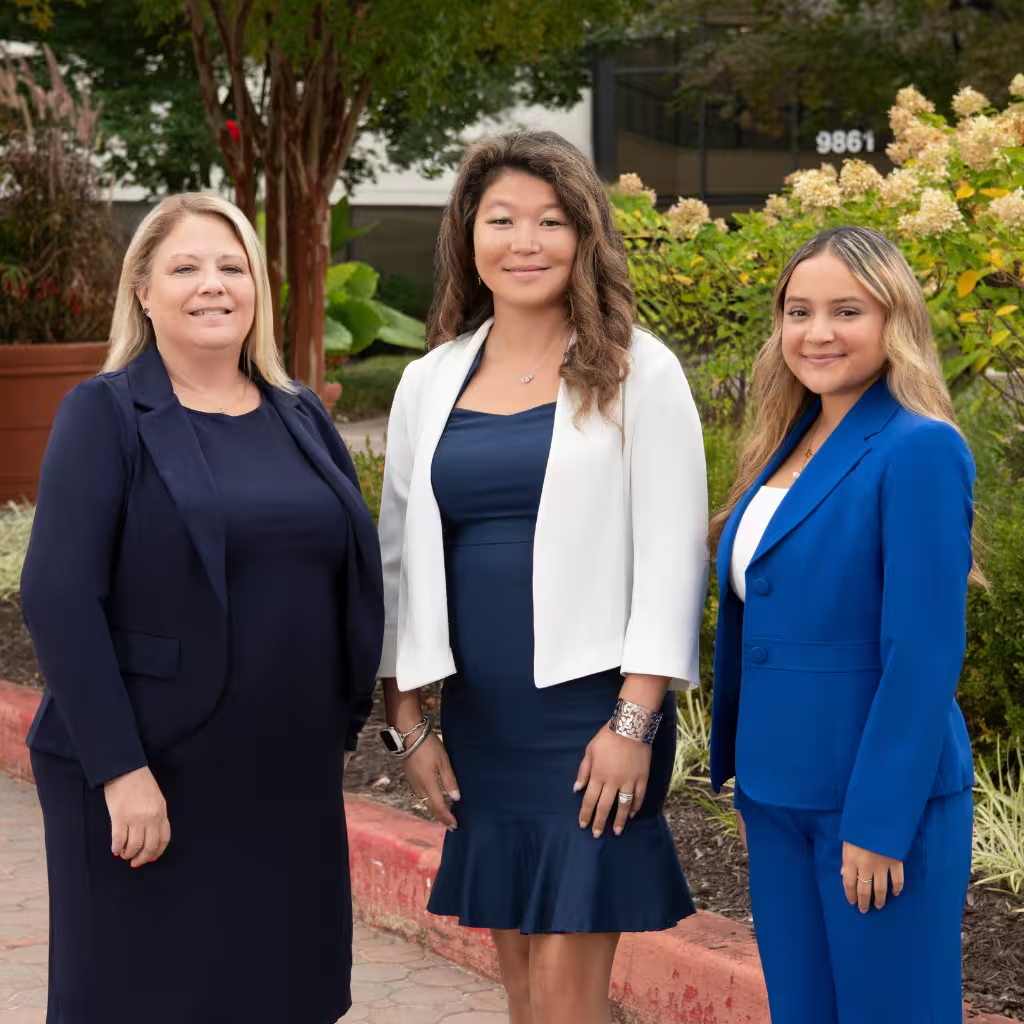
A Career Shaped by Relationships, Not Just Casework
Jacobs’ route to Ruben Law Firm included several professional stops. Before joining the firm in spring 2021, she practiced at Milstein Siegel, Ward & Co. and The Collaborative Law Group.
Each environment introduced her to different attorneys, cases, working styles, and professional relationships. Yet when she reflects on those years, the value she places on them extends beyond the legal experience itself.
The relationships she developed with other attorneys became an important part of her professional growth. Some working relationships eventually became friendships, giving her a network built through experience and mutual respect.
For Jacobs, the legal profession has never needed to function as a battlefield. The people she encountered along the way became colleagues, mentors, friends, and professional connections. Those relationships eventually became one of the quieter but more meaningful parts of her career.
Respect Was Earned One Case at a Time
Early in her legal practice, Jacobs encountered attorneys who challenged younger lawyers and sometimes made them feel less knowledgeable than they were.
She chose not to retreat from those encounters. Instead, the experience pushed her to work harder and demonstrate what she knew through her practice.
The most meaningful form of recognition came later, when some of the same attorneys who had once questioned her began asking for her opinion on cases or referring matters to her. For Jacobs, that represented a different kind of professional achievement. It was not simply recognition through an award. It was respect earned from people who had once doubted her abilities.
The experience also changed how she approaches younger attorneys. Rather than repeating the kind of gatekeeping she had experienced, Jacobs believes in helping, teaching, and assisting others instead of attempting to make them feel inferior.
Keeping Compassion Without Losing Legal Judgment
Family law demands more than legal knowledge. Clients often arrive while dealing with situations that are emotionally overwhelming, and Jacobs has developed a deliberate approach to remaining supportive without allowing the emotional weight of a case to compromise her judgment.
She tries to remain grounded and rational when clients are experiencing strong emotions. She cares about what her clients are going through, but she also recognises that her responsibility is to provide clarity when emotions make clear thinking difficult.
That boundary also includes understanding where her role ends. Jacobs has referred clients to therapy when she believes they need support beyond what an attorney can provide. She does not present herself as a therapist, even though she recognises that clients sometimes need someone willing to listen.
There are days when clients simply need to explain what is happening in their lives, and Jacobs provides that listening ear. At the same time, she maintains an open and honest line of communication, even when the information she has to provide may not be what a client wants to hear.
A Broad Legal Background Behind a Focused Practice
Although family law is now at the centre of Jacobs’ practice, her earlier experience across different areas of law continues to influence the way she handles cases.
Her background includes car accidents, personal injury, bankruptcy, and DUI cases. That breadth can become particularly useful in family law, where one client’s situation may involve several legal issues at the same time.
A family law matter may involve a protective order, criminal charges, divorce, and custody issues, with each element affecting the others. Jacobs’ earlier experience allows her to consider how those different areas of law can interact and how they may affect her client’s rights and responsibilities.
What began as an unconventional route through the legal profession has therefore become an important part of her current practice. The wider experience gives her another way of looking at the problems her clients bring to her.

Recognition Built Through Consistency
Jacobs’ professional recognition has developed steadily over the course of her career. She has been named a Super Lawyers Rising Star repeatedly across nearly a decade, including from 2016 through 2021 and again in 2023, 2024, and 2025.
The recognition represents peer acknowledgement within the legal profession, something Jacobs values because it allows her to stand out among her peers while also recognising the work she has built over time.
Her professional credentials extend beyond that recognition. She has also been named among America’s Most Honoured Lawyers and Top Attorneys in Maryland, received Elite Lawyer honours and a MyLegalWin Top Attorney distinction, and has been a member of the Maryland Bar since 2012 and the Federal Bar since 2016.
Jacobs has served as a Notary Public of the State of Maryland since 2001 and volunteers with the Howard County Family Law Program, extending her legal experience to people who may otherwise have limited access to it.
The Cases That Matter Long After the File Closes
For Jacobs, professional accomplishment is not ultimately defined by a plaque or a title.
Among the cases that remain most meaningful are those in which a judge ultimately ruled in her client’s favour after the matter could not be settled. Having a judge make that decision in favour of her client represents one of the biggest accomplishments she identifies in her work.
Yet the most meaningful moments often come afterward. Jacobs remembers seeing clients in happy tears, embracing family members, and experiencing the relief that follows the resolution of an enormous burden.
There is another form of recognition that matters just as much to her. Former clients who return by referring someone else to her. When a person who has already experienced her work chooses to send another person in need of legal help, the referral becomes a reflection of the trust developed during the original case.
Practicing in the Community That Raised Her
Many attorneys eventually move away from the communities where they grew up in search of larger markets and larger firms. Jacobs chose a different path.
She has lived in Carroll County for most of her life and now practices from the Ruben Law Firm’s Westminster office, serving the same community that shaped her.
That connection influences how she works with clients. Familiarity with the community helps her feel approachable and relatable, while also making it easier to understand the circumstances surrounding the people who come into her office.
In emotionally difficult situations, that familiarity can help establish trust. Jacobs believes understanding the community also helps her determine how to approach different clients and how to communicate with them.
For families dealing with divorce, custody disputes, or other difficult legal circumstances, her connection to the area is therefore part of the way she practices rather than simply a detail about where she works.
Knowing When the Case Has to Stay at the Office
Family law does not always respect traditional working hours. The emotional demands of the profession can easily follow an attorney home, making boundaries between professional responsibilities and personal life difficult to maintain.
Jacobs acknowledges that having a strong home life is important in managing the demands of family law. She has had to learn to put down her phone, step away from cases, and focus on her family.
Her home includes her husband, two children, two cats, and a dog. Maintaining that space requires conscious effort because professional demands do not always remain neatly contained within office hours.
She does not describe the balance as perfect. Sometimes one responsibility takes priority over another. For Jacobs, the important lesson is knowing when to step away, because cases can otherwise consume the space meant for everything else.
Every Family Brings a Different Case
After more than a decade in family law, Jacobs returns to one message when speaking to people who may eventually need legal representation: no two cases are truly the same.
Two situations may appear similar on paper, but the people involved are different, their circumstances are different, and the way each case unfolds can therefore be different as well.
She encourages people to listen to friends, family members, coworkers, and others who may have experienced something similar. At the same time, she emphasises that people ultimately have to understand their own circumstances and determine what is right for them with appropriate legal guidance.
That respect for client autonomy is central to her approach. Her role is to advise and advocate rather than dictate. Listening before judging, understanding the individual behind the case, and protecting the trust between attorney and client remain important parts of that philosophy.
Staying Rooted While Looking Ahead
Jacobs does not describe her future as a dramatic reinvention. Instead, she sees it as a continuation of the work she is already doing.
She expects to remain in Carroll County, continue practicing law, and run the Carroll County branch for her firm. She also sees herself becoming more involved with the local bar association while continuing to represent clients and contribute to the legal community around her.
For attorneys beginning their own careers, her advice is straightforward. Find a passion, continue learning, and remain open to different ways of practicing. Learning a new technique or observing how another attorney approaches a case can add to professional development.
She also recommends practical exposure before entering the courtroom. Finding an attorney to shadow or attending trials in person can help future lawyers understand the rules and realities of courtroom practice in a way that classroom learning alone cannot provide.
The Reputation Built in the Small Decisions
There is no single dramatic moment that fully explains Sarah K. Jacobs’ career. Instead, her professional identity has been shaped through a series of decisions repeated over time.
She chose to pursue a law degree while working and raising a young child. She entered the area of law she had once promised herself she would avoid. When experienced attorneys questioned her abilities, she responded through her work rather than stepping away. And rather than leaving the community where she was raised, she chose to build her practice there.
None of these decisions needed to become a headline on their own. Together, however, they created a professional reputation built case by case and client by client.
For Jacobs, that reputation rests on being honest even when the truth may be difficult to hear, advocating strongly for the people who need her, and remembering that every legal matter represents a family trying to find its way through a difficult period.
The result is a career built not around spectacle, but around something far more personal and enduring: trust.