
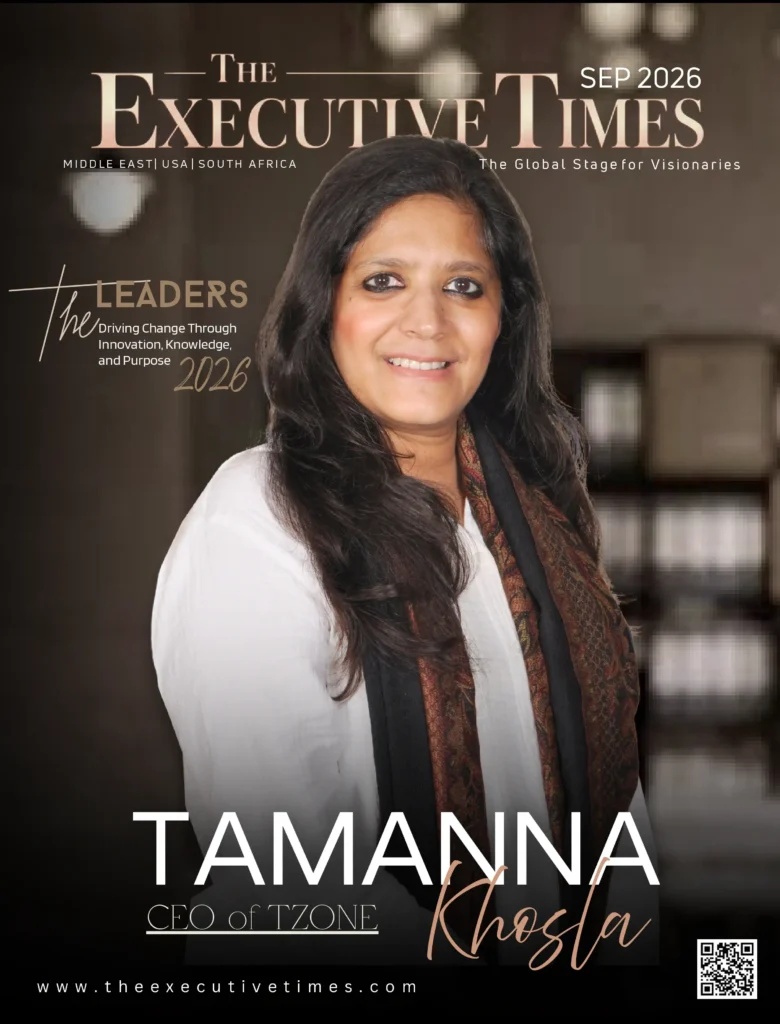
Cover Story -
Tamanna Khosla
CEO of TZONE
"The Leader Driving Change Through Innovation, Knowledge, and Purpose 2026"
Dr. Tamanna Khosla: A Career Rebuilt Beyond the Institution
A political philosopher who became a legal scholar and institution builder, carrying the same questions of power, freedom, and oppression through every chapter of her professional life.
When Academia Closed One Door, The Work Continued
Dr. Tamanna Khosla’s academic journey was never defined by a single discipline. Her early curiosity was directed toward science, but by her senior secondary years, political science and the humanities had become the stronger interests. At Lady Shri Ram College, her engagement with feminism and international relations began to develop, while her master’s studies at Jawaharlal Nehru University took her deeper into questions surrounding politics, oppression, and gender. By the time she reached her M.Phil and PhD, law and philosophy had also become important parts of her intellectual direction.
Her doctorate eventually led to a teaching position at Delhi University, but the appointment came to an abrupt end. Khosla attributes her removal to academic animosity and says that a group within the system subsequently made it difficult for her to secure another academic position. The academic path had been interrupted, but her intellectual work did not stop there. She went on to write ten books, complete a law degree, and establish herself beyond the university system as a public intellectual, legal scholar, and feminist thinker.
The change in direction became another chapter rather than an ending. Her work continued to revolve around the questions that had shaped her earlier studies, while the forms through which she pursued them expanded beyond the classroom.
Faith Remains Her Most Reliable Compass
For Khosla, difficult decisions are not primarily guided by professional frameworks, analytical models, or conventional measures of success. She identifies faith as the constant behind her choices, describing her belief in a higher power and spiritualism as the force she has continued to rely upon when determining which direction to take.
That belief has remained present through different stages of her career. Even as her work moved from academic study toward legal scholarship and institution building, faith continued to provide the foundation through which she understood difficult choices and uncertain paths.
Reading People Without Needing to Be Seen Doing It
Khosla identifies three influences that have consistently shaped the way she approaches life and work: faith in goodness, trust in God, and the ability to read people accurately without making that ability obvious. Among these, understanding people is perhaps the most understated part of her approach.
It is not presented as a skill that needs recognition. Instead, it operates quietly in the background, influencing how she interprets people, relationships, and situations around her. For Khosla, understanding the people involved in a situation is part of understanding the situation itself.
Together, these influences form a personal framework through which she evaluates circumstances and makes decisions, combining belief with an attentive reading of the people around her.
Seeing the Answer Before the Question Is Fully Formed
Khosla believes she can often identify a possible solution before others have completely articulated the problem. She connects this ability not simply to instinct, but to an ongoing commitment to learning from almost every possible source.
People from different countries and generations, unexpected situations, and even organisms can become sources of knowledge in her approach. Nothing is automatically excluded from consideration if it can provide a new piece of understanding.
That habit of observing broadly allows her to approach problems from more than one direction. For Khosla, constant learning is therefore not separate from problem-solving. It is the foundation that makes it possible to recognise possibilities before a question has been fully defined.
A Research Vision Reserved for Unconventional Thinkers
The institution Khosla is now working toward reflects the same expansive approach to knowledge. Her proposed research organization is intended to bring together what she describes as “nerds and geniuses” from anywhere in the world, creating an environment built around people she believes can contribute to difficult and unconventional questions.
Its intended scope is deliberately broad. The organization would examine contemporary global challenges alongside questions extending toward extraterrestrial possibilities, while working toward the development of new philosophical and legal frameworks.
At the centre of that work is the examination of oppression across race, class, gender, geography, and society. The institution therefore reflects the same intellectual concerns that have remained present across Khosla’s academic and professional journey.
Resources First, Then Freedom to Do the Work
The next five years of Khosla’s vision are heavily focused on creating the financial foundation needed to establish this institution. Her objective is to secure enough resources to bring the right people into the organization and provide them with what they need to pursue the work alongside her.
For Khosla, financial limitations should not prevent capable people from contributing to meaningful research. The issue is not simply obtaining money for expansion, but removing a barrier that could otherwise restrict talented minds from pursuing difficult questions.
The approach is therefore centred on creating the necessary financial runway first, assembling the people she believes are right for the work, and giving them the freedom to concentrate on their ideas without constantly being constrained by a lack of resources.
A Personal History Marked by Resistance
The challenges Khosla describes extend well beyond professional setbacks. She speaks of severe oppression within her own family as well as within Indian society and academia, describing experiences that continued over decades.
She frames that period as a struggle she faced as a woman without support from those around her. Despite the absence of that support, she identifies one source of help that remained constant throughout the experience: God.
Her account of resistance therefore remains closely connected to the faith that she identifies as the foundation of her decision-making. The two themes continue to appear together when she describes both the difficulties she encountered and the way she moved through them.
Learn From Exceptional Minds Without Becoming Their Reflection
Khosla’s advice to people seeking influence in her field rests on a distinction between learning and imitation. She believes intelligence and achievement in others should not create envy. Instead, people should study those who are more accomplished, learn from their work, and use those lessons to develop their own direction.
At the same time, she draws a clear line around imitation. Another person’s work belongs to that person, and learning from excellence should not mean attempting to reproduce someone else’s identity or contribution.
Her thinking around financial resources follows a similar principle. Money has an important role, but it should not become the central reason for creating something whose broader purpose is connected to freedom and egalitarianism.
For Khosla, exceptional thinkers should have respect, resources, and the freedom to pursue ideas without unnecessary restrictions. That is the culture she hopes the institution she is building will carry forward, extending the same intellectual independence that has shaped her own journey.