
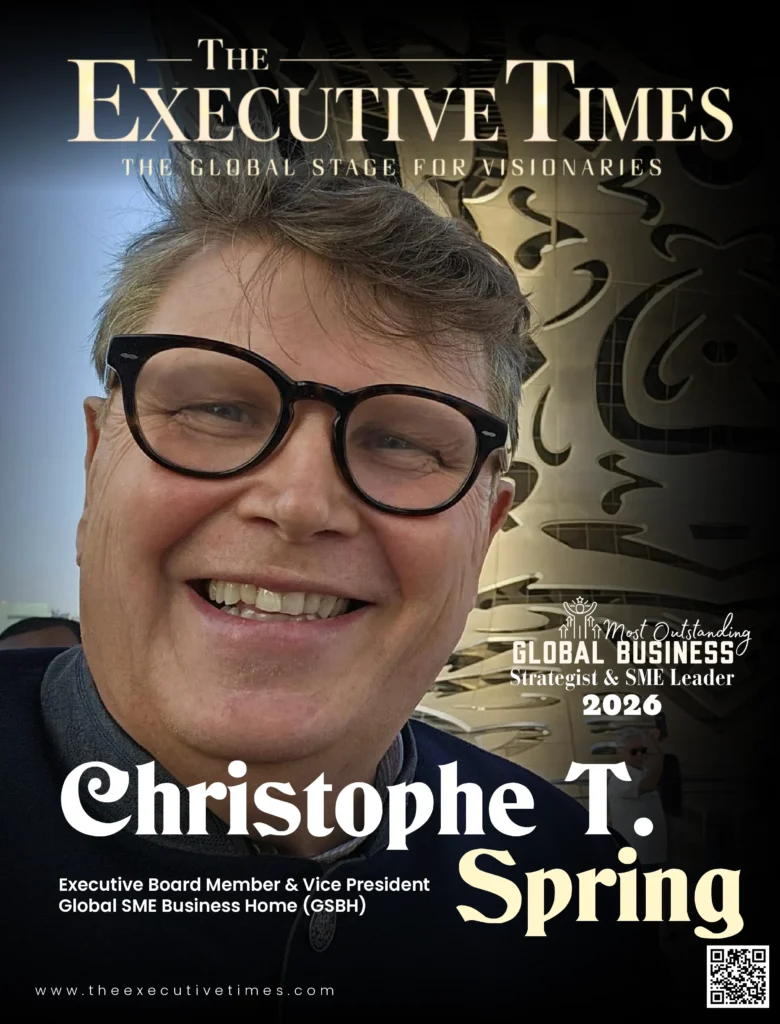
Cover Story -
Christophe T. Spring
Executive Board Member & Vice President at Global SME Business Home (GSBH)
"Most Outstanding Global Business Strategist & SME Leader – 2026"
The Business of Trust: How Christophe T. Spring Built Bridges Across Global Markets
From a 58% share of Switzerland’s luxury tabletop market to international travel retail and advising Mackwoods, the Swiss executive’s four-decade career reveals why lasting business success begins with people, not transactions.
A traveller rushing through an international airport gives a chocolate bar perhaps three seconds of attention. In that fleeting moment, its packaging, origin, colours and reputation must do the work of an entire sales team.
Christophe T. Spring understands those three seconds remarkably well.
But after more than four decades in international business, the Swiss executive has learned something more important: attracting attention is relatively easy. Earning trust, delivering on promises and building relationships that survive changing markets is considerably harder.
His career has crossed luxury tableware, Swiss confectionery, international travel retail, premium real estate and cross-border business development. It has taken him through more than 36 countries across Europe, North America, the Gulf and Asia.
Along the way, he has represented internationally recognised luxury brands, helped develop new markets for Swiss confectionery, managed complex restructuring assignments and built relationships extending from corporate boardrooms to diplomatic circles.
In April 2026, Spring attended a General Audience with His Holiness Pope Leo XIV at the Vatican in Rome. The experience offered a perspective beyond the commercial environments that have shaped much of his career, reflecting his longstanding interest in dialogue, cultural understanding and the relationships that connect people across borders.
Today, Spring serves as Vice President and Executive Board Member of GSBH Global SME Business Home Switzerland and Senior Executive Advisor to Mackwoods Group, whose business heritage stretches from Sri Lanka to the United Kingdom.
His responsibilities have evolved from operational management towards strategic advisory work, international market development and connecting businesses across cultures.
Yet the most revealing chapters of his career are not necessarily the most successful ones. They include an order for two containers that never shipped, a restructuring affecting an entire workforce, an experienced saleswoman who transformed his approach to selling and a parachute jump over Canada that taught him something about taking calculated risks.
The common denominator is trust.
The Bern Blueprint: Building Relationships Before Digital Networks
Long before LinkedIn, digital networking platforms and instant international communication, a young Spring was learning the fundamentals of cross-border cooperation through Junior Chamber International.
In the mid-1980s, he helped establish a twinning arrangement, known as a jumelage, between the JCI chambers of Bern and Paris. Together with international colleagues, he subsequently organised two meetings connecting members from Bern, Paris and London.
These initiatives required more than exchanging business cards. There were invitations to arrange, cultural differences to navigate, commitments to honour and friendships to maintain.
International relationships were built through personal effort, one conversation and one shared experience at a time.
The experience shaped an understanding that would accompany him throughout his career: a network’s value is not determined by the number of contacts it contains, but by whether those people trust one another enough to act.
JCI also provided an early education in leadership. Spring learned to organise, negotiate, persuade and accept responsibility for decisions, including those that did not produce the expected results.
What began as voluntary international cooperation gradually became a professional philosophy.
The Saleswoman Who Changed Everything
One of Spring’s most enduring business lessons came from an unlikely competitor: an experienced saleswoman with white hair who consistently reached the most important customers before he did.
Frustrated by her success, he eventually asked what she knew that he did not.
Her answer changed his approach to selling. She told him that the product alone was never enough. He had to bring his personality, knowledge and experience into the relationship.
Spring began listening more carefully, asking better questions and moving beyond conventional product presentations. The results followed.
Products could be copied. Prices could be matched. Marketing campaigns could be replicated. Personal credibility was considerably harder to reproduce.
That distinction would become particularly important as his career moved into luxury markets, where confidence, emotion and perception often influence purchasing decisions as much as technical specifications.
Eleven Luxury Houses and a 58% Market Share
At Rosenthal Switzerland, Spring entered an environment where branding, presentation and commercial discipline had to work together.
As Managing Director, he was responsible for a portfolio of eleven international luxury brands and the Rosenthal Studio House network, with business responsibilities extending across Switzerland and southern Germany.
The portfolio included internationally recognised names such as Versace, Bvlgari, Waterford, Wedgwood and Rosenthal.
During his tenure, Rosenthal achieved a reported 58% market share in Switzerland’s luxury tabletop market, establishing a dominant position in the premium segment.
The role demanded extensive travel, sometimes exceeding 100,000 kilometres annually, and required him to manage relationships with retailers, commercial partners and brand principals.
Yet Spring considers his exposure to Philipp Rosenthal among the most influential experiences of this chapter.
Rosenthal understood that successful luxury brands required more than beautiful products. They needed design integrity, visibility, compelling presentation and people capable of communicating their value.
Spring took three enduring lessons from that environment. First, premium positioning must be protected. Second, even an exceptional product needs visibility and a reason to be desired. Third, the person representing a brand is an essential part of the customer experience.
The distinction between expensive merchandise and genuine luxury, he learned, often lies in the quality of the people surrounding it.

When Leadership Becomes Uncomfortable
Spring’s career was not confined to brand development and commercial expansion.
At Creative Hobbies Group, he became involved in restructuring European distribution operations ahead of a business sale. The assignment concerned three distributors and a workforce of 71 employees.
Restructuring is easily reduced to financial language: cost reductions, operational efficiencies, margin improvement and transaction readiness. Spring saw the human consequences behind those figures.
Employees had careers, families and expectations. Management decisions could change their circumstances considerably.
His conclusion was not that difficult decisions should be avoided. Businesses sometimes require substantial restructuring to survive or remain competitive. But the process matters.
Clear communication, respect and accountability are not optional extras during organisational change. They are fundamental leadership responsibilities.
The experience reinforced his conviction that professional integrity becomes most visible when circumstances are uncomfortable.
Flying the Swiss Flag: From Camille Bloch to Kägi
Spring’s work in Swiss confectionery brought together his experience in premium branding, international distribution and consumer psychology.
At Chocolats Camille Bloch, the company behind Ragusa, and later Kägi Söhne AG, he worked on developing international markets and travel retail opportunities.
The Swiss flag became an important element of his approach to brand positioning. In airports and duty-free environments, where travellers encounter dozens of competing products, national origin can provide an immediate point of recognition.
Swissness communicates associations with quality, craftsmanship, reliability and tradition. But Spring also understood its limitations.
A Swiss flag may attract the first glance. It cannot compensate for disappointing quality, poor distribution or inappropriate pricing.
His involvement in international development at Kägi illustrated the commercial complexity behind seemingly simple retail displays.
In April 2023, Kägi entered a partnership with Kreol Travel Retail to develop opportunities in India, Sri Lanka and the Arabian Gulf. Subsequent market introductions included Delhi Duty Free and Abu Dhabi’s Zayed International Airport.
Such achievements require more than a recognisable brand. They depend on market access, distributor selection, commercial negotiation, regulatory understanding and the ability to translate a domestic product proposition into an international retail environment.
For Spring, the lesson remained consistent: heritage may open the conversation, but execution determines whether the business lasts.
From Chocolate Counters to Luxury Residences
Another career transition took Spring into international luxury real estate.
His involvement with Rockefeller Estates in Geneva and projects including the Kempinski Residences at Du Parc Mont Pèlerin exposed him to a market where purchasing decisions followed a fundamentally different rhythm.
The historic property, originally dating from 1908, was transformed from a traditional hotel environment into a collection of exclusive residences.
Unlike consumer goods, luxury property cannot rely on rapid purchasing decisions or promotional urgency. Clients require discretion, confidence, patience and detailed knowledge.
Spring discovered that many principles from luxury retail remained relevant: provenance, scarcity, presentation and personal relationships. But one difference stood out.
In high-value transactions, knowing when not to push can be as important as knowing how to sell.
The experience broadened his understanding of commercial timing and reinforced the importance of respecting the customer’s decision-making process.
Two Containers, One Order and a Difficult Lesson
Perhaps the most instructive commercial setback of Spring’s career occurred during an early expansion initiative in India.
He travelled to New Delhi and Mumbai with an approved business plan and pricing structure. Within approximately three months, he had secured an order equivalent to two 40-foot containers.
For a new-market initiative, it represented a promising commercial breakthrough.
Then the project encountered a problem that had little to do with Indian customers or market demand. The organisation behind the initiative was not sufficiently prepared to execute the opportunity. The order was never fulfilled.
For Spring, the experience exposed a weakness that remains common in international expansion strategies.
Companies invest heavily in market research, customer acquisition, pricing and distribution forecasts. Yet they sometimes neglect to assess their own operational readiness.
Can the organisation produce the required quantities? Can it finance the order? Can management make decisions quickly enough? Is the supply chain capable of delivering what the sales team has promised?
The experience changed the questions Spring asks management teams. Before celebrating a potential market opportunity, he wants to understand whether the business can actually support success.
It is an uncomfortable question, but one that can prevent expensive mistakes.

Mackwoods: Bringing 185 Years of Heritage Into New Markets
Spring’s appointment as Senior Executive Advisor to Mackwoods Group in 2026 marks a new chapter in his international career.
The relationship brings together two complementary strengths: an established business with roots dating to 1841 and an executive whose professional experience has centred on taking heritage brands into international markets.
Mackwoods is no ordinary newcomer to the premium tea industry. Established in Ceylon during the nineteenth century, the business developed into a longstanding commercial name associated with Sri Lanka and the United Kingdom.
Its heritage spans fine Ceylon teas, international trading and relationships reaching into British institutional and royal circles.
The Mackwoods tea portfolio includes single-estate and unblended teas, traditional black and green teas, rare Silver Tips and Golden Tips, and commemorative blends associated with significant royal occasions.
Mackwoods holds a Royal Warrant of Appointment as a supplier of fine teas to His Majesty King Charles III, a distinction that reinforces its longstanding association with the British Royal Household.
For Spring, this recognition represents both an asset and a responsibility. Royal recognition may strengthen a brand’s international credibility, but lasting commercial success still depends on product quality, authenticity and the ability to meet customers’ expectations.
His advisory focus includes opportunities in European and GCC travel retail, where premium tea competes for attention alongside confectionery, spirits, fragrances and luxury gifts.
The commercial challenge is considerable. Unlike Swiss chocolate, which already enjoys widespread recognition as an airport purchase, premium tea must often explain its value to customers unfamiliar with individual estates, harvesting methods or specialist grades.
A traveller may understand the price difference between two watches or two bottles of whisky. Understanding why one tea commands a substantial premium over another requires a different form of communication.
That is where Spring’s experience in luxury branding and international retail becomes relevant.
The opportunity is not simply to place another tea product on an airport shelf. It is to develop a proposition that connects origin, craftsmanship, packaging and consumer expectations.
Premium hotels, luxury hospitality and carefully selected travel retail channels offer potential avenues for this positioning.
Spring’s role is advisory and strategic: helping identify appropriate markets, commercial partners and distribution opportunities while respecting the identity of a heritage business.
It is also a different stage of professional responsibility. Rather than managing every operational detail himself, his contribution increasingly lies in evaluating opportunities, identifying risks and connecting the right people.
The Mackwoods relationship also brings him into contact with Dr. Chris Nonis, Chairman of Mackwoods Group and former Sri Lankan High Commissioner to the United Kingdom.
Nonis’s background in business and diplomacy provides a natural point of connection with Spring’s own involvement in international commercial and diplomatic networks.
Their professional relationship sits at the intersection of enterprise, international understanding and cross-cultural cooperation.
For Spring, Mackwoods represents an opportunity to apply decades of accumulated experience to a heritage brand seeking further international opportunities.
It also brings his career full circle. From Swiss chocolate to Ceylon tea, the products have changed. The central commercial question has not: how can a distinctive product earn attention, establish credibility and build a lasting relationship with customers?
Beyond Business Cards: The GSBH Mission
Spring’s involvement with GSBH Global SME Business Home Switzerland reflects another dimension of his professional activities.
As Vice President and Executive Board Member, he works to connect businesses, entrepreneurs, investors and international networks.
The objective is not simply to introduce people. Effective business relationships require an understanding of commercial expectations, cultural differences and the capabilities of the organisations involved.
A promising introduction is only the beginning.
Spring believes that many international opportunities fail because the parties involved underestimate the importance of trust, communication and follow-through.
His experience across different industries has also taught him to recognise situations in which a proposed partnership may look attractive on paper but lacks the foundations required for success.
Increasingly, his contribution is less about being the person who closes every transaction and more about helping others identify opportunities worth pursuing.
India: Building Bridges Rather Than Walls
In August 2026, Spring travelled from Switzerland to Indore in Madhya Pradesh as an invited European guest speaker at an Indian industry and SME summit.
His message was straightforward: build bridges, not walls.
For Spring, India represents far more than a large consumer market or a low-cost manufacturing destination. He sees an increasingly ambitious SME sector interested in international partnerships, technology, investment and global expansion.
He argues that European businesses should move beyond viewing India primarily as a sourcing opportunity. Indian entrepreneurs are potential strategic partners, with expertise, market knowledge and international ambitions of their own.
But partnerships require more than signing a memorandum of understanding or exchanging business cards at a conference. They demand continuity, mutual respect and an appreciation of different business cultures.
Spring’s journey to Indore involved substantial time and travel without a guaranteed commercial return. That did not particularly trouble him.
After four decades in international business, he has learned that not every valuable relationship begins with a measurable return on investment.
Some opportunities develop over years rather than quarters. And sometimes the first meaningful result of an international journey is simply that two people who previously knew nothing about one another begin to trust each other.

The People Behind the Professional
Despite a career involving luxury brands, corporate leadership and international business development, Spring is reluctant to attribute his professional education to any single mentor.
Philipp Rosenthal influenced his understanding of brand positioning and entrepreneurship. Experienced salespeople taught him the importance of personality and listening.
Retailers taught him that a commercial strategy is only as good as its performance in front of customers. Diplomats demonstrated the importance of language, timing and cultural sensitivity.
And difficult managers taught him lessons about the kind of leadership he did not wish to practise.
Some of his most enduring advice came from his grandmother. She frequently reminded him of the German proverb: “Wie man in den Wald hineinruft, so schallt es heraus.”
The way you call into the forest determines the echo you receive.
Spring regards the saying as more than family wisdom. For him, it expresses a fundamental principle of leadership: the respect, fairness and credibility one extends to others have a way of returning, sometimes years later and in unexpected circumstances.
Seven Thousand Feet Above Canada
When asked about courage, Spring does not immediately turn to an international acquisition, a challenging negotiation or a difficult management decision.
Instead, he remembers a journey through Canada.
He was travelling with a friend and the friend’s Inuit wife when she challenged him to attempt a tandem parachute jump from approximately 7,000 feet. He accepted.
Within fifteen minutes, he had completed the paperwork, put on a jumpsuit and boarded an old Junkers aircraft with experienced Canadian parachutists.
Just before the jump, the instructor asked whether he wanted to experience something special. Spring agreed without fully understanding what was coming.
Moments after leaving the aircraft, the pair began a series of somersaults that left him struggling to distinguish sky from ground. Then the parachute opened. The sudden silence was extraordinary.
Shortly afterwards, the instructor invited him to take part in guiding the landing. It was Spring’s first parachute jump.
He landed safely, having surprised both himself and the woman who had issued the challenge.
The episode has remained with him because it captures something important about his approach to life and business.
Preparation matters. Expertise matters. Understanding risk matters. But opportunities do not always arrive when people feel completely ready.
Sometimes the decision has to be made before every uncertainty has disappeared.
A Different Definition of Success
Spring’s career has included substantial commercial achievements, international recognition and professional setbacks.
It has also taken him through industries that, at first glance, have relatively little in common.
Fine porcelain, Swiss chocolate, luxury real estate and premium Ceylon tea may appear to require entirely different forms of expertise. Yet his experience suggests that the underlying commercial principles are surprisingly consistent.
A business must understand its customers, protect its positioning, deliver on its promises and build relationships capable of surviving difficult moments.
At Mackwoods, those principles now inform his strategic advisory work around a heritage brand with international ambitions. At GSBH, they shape his efforts to connect entrepreneurs, companies and markets.
And in his conversations with business leaders, they lead him to challenge an assumption that has become increasingly common in modern management: that speed, scale and technology can substitute for personal credibility.
They cannot.
Technology may accelerate an introduction. It cannot guarantee trust. A strong brand may attract attention. It cannot compensate for poor execution. And an impressive title may open a door. It cannot ensure that the door remains open.
Four decades, more than 36 countries, eleven luxury brands, two containers that never shipped and one unforgettable parachute jump over Canada.
Christophe T. Spring has learned that business success rarely follows a straight line.
Markets change. Titles disappear. Strategies fail. Even promising opportunities sometimes collapse.
What remains is the reputation built along the way.
And perhaps that is the most meaningful measure of a career: not how many doors you have opened, but how many people would willingly open theirs for you again.