
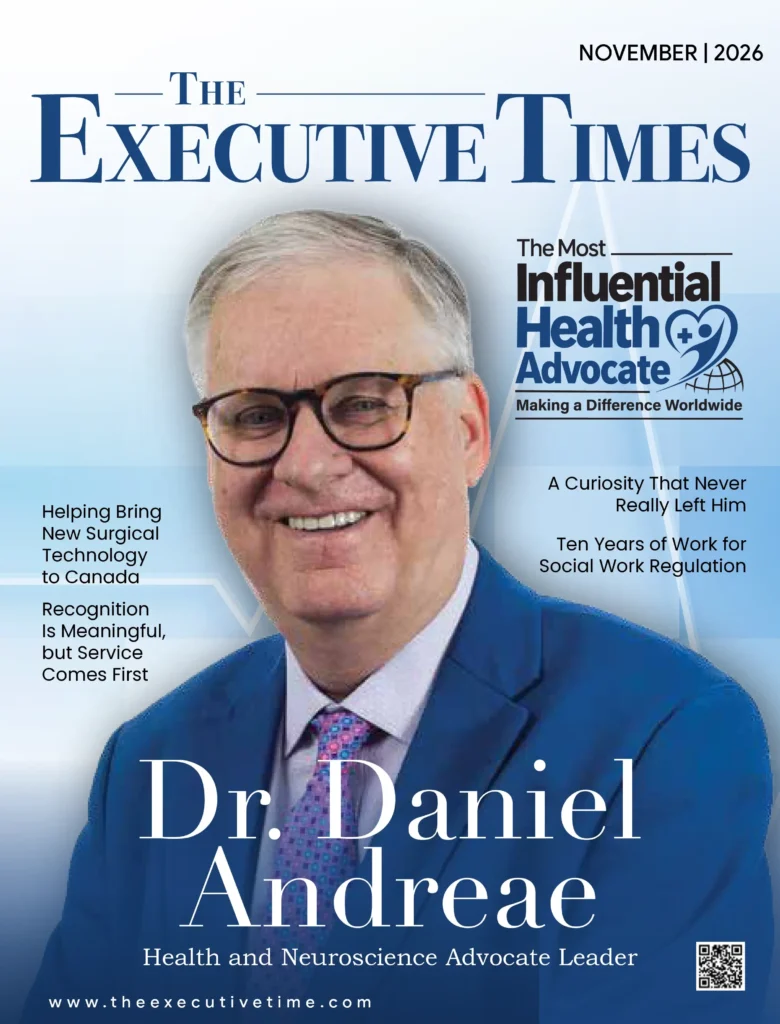
Cover Story -
Daniel Andreae
Health and Neuroscience Advocate Leader
"The Most Influential Health Advocate Making a Difference Worldwide"
A curiosity that never really left him
Dr. Daniel Andreae has always been interested in understanding people. Why do we think the way we do? What shapes our behaviour? And how do our experiences, relationships and surroundings affect the way we live? These questions stayed with him long before he became an educator, healthcare advocate and institution builder.
His academic journey began at York University in Toronto, where he completed a bachelor’s degree in psychology. He then went on to Wilfrid Laurier University for a master’s degree in clinical social work and received a doctorate in education at the University of Toronto. The two subjects gave him different but connected ways of looking at people. Psychology helped him understand the individual, while social work showed him how families, communities and larger systems can influence a person’s life.
He was never someone who felt that learning should stop after earning a degree. He has studied health coaching at the Functional Institute of Nutrition.
His professional development included becoming a Founding Fellow of the Institute of Coaching at McLean Hospital in Boston. He later earned a non-traditional PhD in Human Biology.
Looking back, these studies were not separate interests for Andreae. They helped him understand how physical health, mental wellbeing, emotions and social circumstances work together. That understanding would become an important part of his work in healthcare and education.
The people who helped shape his approach
Andreae is quick to acknowledge that he did not build his career entirely on his own. Teachers and mentors played an important role, particularly Dr. Eva Philipp, his graduate school supervisor.
Her influence went beyond academic guidance. She helped him understand that knowledge and professional experience should come with a responsibility to serve others. Their relationship continued over the years and eventually grew into a lifelong friendship.
That lesson can still be seen in the way Andreae approaches his work. He does not look at a career simply as a series of positions or achievements. For him, it has been about learning from others, making use of opportunities and helping people along the way.
He has also tried to pass on the support he received. Whether through teaching, scholarships or healthcare initiatives, he believes people should be given opportunities to develop their abilities and make a difference.
Almost 25 years in the classroom
Teaching became one of the most important parts of Andreae’s professional life. For nearly 25 years, he taught at universities and colleges, covering 45 different subjects across psychology, social work, optimal health, the humanities and bioethics.
His teaching career brought recognition from several institutions. He received Distinguished Teaching Awards at the University of Waterloo and was named a Fellow of Renison University College. At the University of Guelph-Humber, students and colleagues selected him as Faculty of the Year twice, while graduating students also named him Mentor of the Year. He later received a Lifetime Achievement Award from Guelph-Humber and an honourary degree from Humber Polytechnic.
Other organisations recognised him as Professor of the Decade and Intellectual of the Year.
But Andreae remembers the classroom for reasons beyond awards. He wanted students to feel comfortable asking questions, sharing their opinions and admitting when they did not understand something. He knew that every student was different and that the same teaching approach would not work for everyone.
One thing he noticed over the years was how much confidence could grow when students felt respected and heard. Watching someone who was initially hesitant become more comfortable with their own abilities was one of the most rewarding parts of teaching for him.
He often expresses his approach through a simple idea: Education is where the head meets the heart. Knowledge matters, but he believes it needs compassion and understanding to make a real difference.
His interest in education continues outside the classroom as well. He funds annual scholarships at Humber, particularly valuing the opportunity to support students who have overcome serious challenges. He has also supported public lectures at Laurentian University and lectures on health and the future of the professions at the Michener Institute.
For Andreae, education does not end when someone graduates. Especially in healthcare and medicine, continuing to learn is important because the knowledge and needs of society keep changing.
When understanding a problem is not enough
Teaching was one way Andreae contributed to society. Building organisations that could support people over the long term became another.
One of his major initiatives was co-founding the National Eating Disorder Information Centre (NEDIC) at Toronto General Hospital, part of the University Health Network. At the time, eating disorders did not receive the level of public attention they needed, and families often struggled to find reliable information or support.
NEDIC helped address that gap by providing education, telephone counselling and technology-enabled support for patients, families, caregivers and professionals. Its purpose was to make sure people dealing with eating disorders did not feel they had to face the experience alone.
Andreae remains connected to the organisation as Chair of its advisory committee.
His next major role was as the first Executive Director of the Alzheimer Society of Toronto, an organisation described in the source as the first of its kind in the world. Alzheimer’s disease was still poorly understood by many people, and families needed more information and practical support.
During his time there, Andreae helped develop public education programmes, support groups and counselling services. He also worked on government advocacy and partnerships with healthcare professionals and nursing homes. One particularly practical initiative was a wandering patient registry developed in cooperation with the police. The idea later spread across Canada.
He understood that an Alzheimer’s diagnosis affects much more than the person receiving it. Families and caregivers also have to adjust their lives, often while trying to understand a condition they know very little about.
His contribution was recognised through the Society’s Lifetime Achievement Award, Outstanding Service Award for Leadership, presented by Princess Yasmin Aga Khan, and later its Pioneer Award. He also chaired the Society’s Patrons Council.
These experiences reflect something consistent in his career. When Andreae sees a gap in support, he looks for ways to build something that can continue helping people beyond his own involvement.
Ten years of work for social work regulation
One of the longest professional challenges Andreae took on came during his time as President of the Ontario Association of Social Workers. He became the longest-serving president in the association’s history, largely because of a campaign that required years of work.
At that time, Ontario was the only jurisdiction in North America without statutory regulation of the social work profession. This meant there were fewer formal protections for the public and the profession did not have the regulatory standing it needed.
Changing that situation took approximately ten years. The effort involved three governments, seven ministers of the Crown and a long period of discussions and negotiations. Andreae worked on building support, developing policy, speaking with editorial boards, meeting civil servants and bringing other health professions into the conversation.
The experience required patience. Progress did not always come quickly, and there were setbacks along the way. But he continued to work towards the larger objective.
When legislation was finally passed, it marked an important change for social workers and public protection in Ontario. Andreae received professional recognition for his contribution, including a Lifetime Achievement Award from the profession.
The campaign also shaped his understanding of leadership. He believes opposition should not automatically be taken as a reason to stop. Sometimes it means a strategy needs to be reconsidered, a stronger case needs to be made or more people need to be brought into the discussion.
For him, meaningful change often takes longer than expected. The important thing is to keep working towards the purpose behind it.
Health is more than treating an illness
Andreae’s work across healthcare and education has given him a particular view of how health should be understood. He often compares healthcare to an airplane with two wings.
One wing represents medical science and technology, including surgery, medication, vaccines and diagnostic tools. The other represents the human side of healthcare: emotions, relationships, personal experiences, fears and hopes.
In his view, both are needed. Medical advances have made an enormous difference in treating conditions such as fractures, appendicitis, diabetes, heart disease and cancer. But he believes healthcare also needs to give more attention to prevention and the factors that influence a person’s overall health.
He sees the brain, mind and body as closely connected rather than separate parts that can be considered independently. The cardiovascular, neurological, digestive, hormonal and immune systems all communicate with one another.
He also places importance on everyday habits. Regular physical activity, balanced nutrition, adequate sleep, stress management, avoiding smoking and excessive alcohol, and maintaining meaningful social connections all contribute to healthier lives.
Social connection is something he particularly emphasises. Loneliness and isolation can have serious consequences for health, and even simple daily interactions can make a difference.
Andreae believes that genetics are only part of the picture. Lifestyle, environment and past experiences also influence how people experience health over time.
Taking stress and mental health seriously
Stress is another subject that has remained important throughout Andreae’s work. His studies at the Benson Henry Mind Body Institute strengthened his interest in the relationship between stress and physical health.
He often refers to the finding that up to 80 per cent of doctor visits are linked to conditions caused or worsened by stress. For him, this highlights a gap in healthcare. Treating a physical symptom without considering the pressures behind it may not address the full problem.
His view is that emotional and psychological care should be considered alongside physical treatment, not as something to be dealt with later.
He supports wider access to evidence-based psychological care delivered by multidisciplinary teams. He also points to research comparing patient satisfaction among people treated by psychiatrists and those supported by trained community-based nurses, which found similar levels of satisfaction.
He recognises that psychiatrists remain essential, particularly when medication is required. At the same time, he believes trained professionals from other disciplines can help respond to growing demand when working within recognised and evidence-based models.
This interest connects many parts of his career. It is present in his work with eating disorder support, Alzheimer’s families and students dealing with personal challenges. In each situation, he has seen how a person’s emotional and psychological wellbeing can affect their overall health.
Helping bring new surgical technology to Canada
Andreae’s interest in healthcare innovation is also reflected in his support for advanced medical technology. He was a lead donor in bringing the da Vinci surgical robot to the University Health Network.
The technology offers surgeons greater precision and supports minimally invasive procedures. Andreae supported the initiative because of the potential benefits for patients, including smaller incisions, less blood loss, lower infection risk, shorter hospital stays and faster recovery.
The project did not move forward without questions. Cost, competing priorities and government funding were all concerns, and some people questioned whether the investment was justified.
Andreae believed the potential patient benefits made the effort worthwhile. He also understood that bringing in new equipment was only one part of the job. Surgeons needed proper training to use it effectively.
Together with his sister, Trish Holt Hornsby, he supported the creation of Canada’s first robotic training academy at the Michener Institute of Education, University Health Network. He also serves on the Michener Institute’s Board of Governors.
His support has extended to other areas of medicine as well, including internationally recognised corneal transplantation programmes led by Dr. Allan Slomovic and advanced brain and stroke interventions led by Dr. Timo Krings.
His approach is quite consistent: identify people with the vision and expertise to move healthcare forward, and help provide the resources they need to do that work.
A longstanding interest in the brain
The brain has been a particular focus of Andreae’s interest, both through his academic background and his support for research and healthcare initiatives.
He is Patron of Brain Injury Canada and supports people living with the effects of brain injuries. He also sponsors the brain laboratory of Dr. Ivo Spiegel at the Weizmann Institute of Science, where he serves on the International Board and chairs the Canadian Advisory Board.
The Weizmann Institute has named him one of ten leading Canadians, welcomed him into its President’s Circle and presented him with its Community Leadership Award.
His interest in brain science also connects with his earlier work at the Alzheimer Society of Toronto, his studies in neuropsychophysiology and his support for stroke intervention research.
For Andreae, these are not simply separate projects. They are connected by a desire to understand the brain better and support work that can improve human health.
He says his involvement is not driven by recognition. He is drawn to research and healthcare initiatives because of their potential to make a meaningful contribution to people.
What the next chapter of healthcare may look like
Andreae believes healthcare is entering an important period of change. Artificial intelligence, robotics and personalised medicine are likely to influence how conditions are diagnosed, how treatments are developed and how patients receive care.
He sees AI helping with earlier diagnoses, drug discovery, digital health records and treatment plans that are better suited to individual patients. Robotics will continue to develop in surgery, and he believes remote procedures may eventually become more common.
But he is also aware that new technology brings responsibilities. Patient consent, privacy of health information and equal access need to be considered from the beginning. Advanced healthcare should not become something available only to people who can afford it.
He also expects nurses, occupational therapists, nutritionists and physiotherapists to play a greater role in community-based care. These professionals can help deliver specialised services at a lower cost and reduce some of the pressure on primary care physicians.
To support this change, Andreae believes colleges and universities should consider targeted micro-certification programmes. These could prepare people for specific healthcare interventions without always requiring lengthy degree pathways.
It is an approach that brings together his experience as an educator and his understanding of how healthcare systems work.
Recognition is meaningful, but service comes first
Over the years, Andreae has received recognition from universities, healthcare organisations and community institutions. Assumption University awarded him an honorary Doctor of Laws in recognition of his contributions to healthcare. Laurentian University also presented him with an Honourary Doctorate of Letters and its inaugural Impact Award.
He has been named a Global Visionary, received a Distinguished Humanitarian Award and been included in Marquis Who’s Who in the World.
His work has also extended into education and community initiatives beyond healthcare. He was the Founding Honorary President of the Patrons Council of Neuchatel Junior College, a Canadian school in Switzerland. He served as Health and Innovation Advisor to the Psychology Foundation of Canada’s Strong Minds Strong Kids initiative and was a past patron of the Canadian Abilities Foundation.
These roles reflect the range of institutions and communities with which he has worked.
When asked how he has changed over the years, Andreae describes himself as more realistic, humble and thoughtful than he was earlier in his career. He says experience has helped him think more broadly and, perhaps most importantly, become a better listener.
He believes leadership is not simply about holding a position or receiving recognition. It is about listening to people, helping them recognise their strengths and making it easier for them to contribute.
The kind of legacy he hopes to leave
Andreae does not place much importance on being remembered for titles or awards. If people remember him, he hopes it will be as a teacher who cared, a leader who listened or someone who tried to make the world a little kinder and wiser.
Still, the work he has been part of has left a practical mark. NEDIC continues to support people affected by eating disorders. The Alzheimer Society has helped families find information and support. The campaign for social work regulation helped strengthen professional standards in Ontario. His support for surgical technology and training has contributed to the development of healthcare capabilities.
There are also the students who became more confident in his classrooms and the researchers whose work he has helped support.
Andreae continues to approach life with curiosity. He often refers to George Bernard Shaw’s idea of imagining things that do not yet exist and asking why they cannot become possible.
Looking ahead, he hopes to remain involved in public education and help organisations reach their potential. It is a continuation of the work he has done for much of his life: understand people, recognise what is missing and help build something that can make a difference.
For future leaders, his message is a simple one. Leadership is not just about a title or a position. It is about noticing where help is needed, learning what it takes to make a difference and having the patience to see the work through, even when it takes years.
For Dr. Daniel Andreae, the head and the heart have always belonged in the same conversation.