
Cover Story -
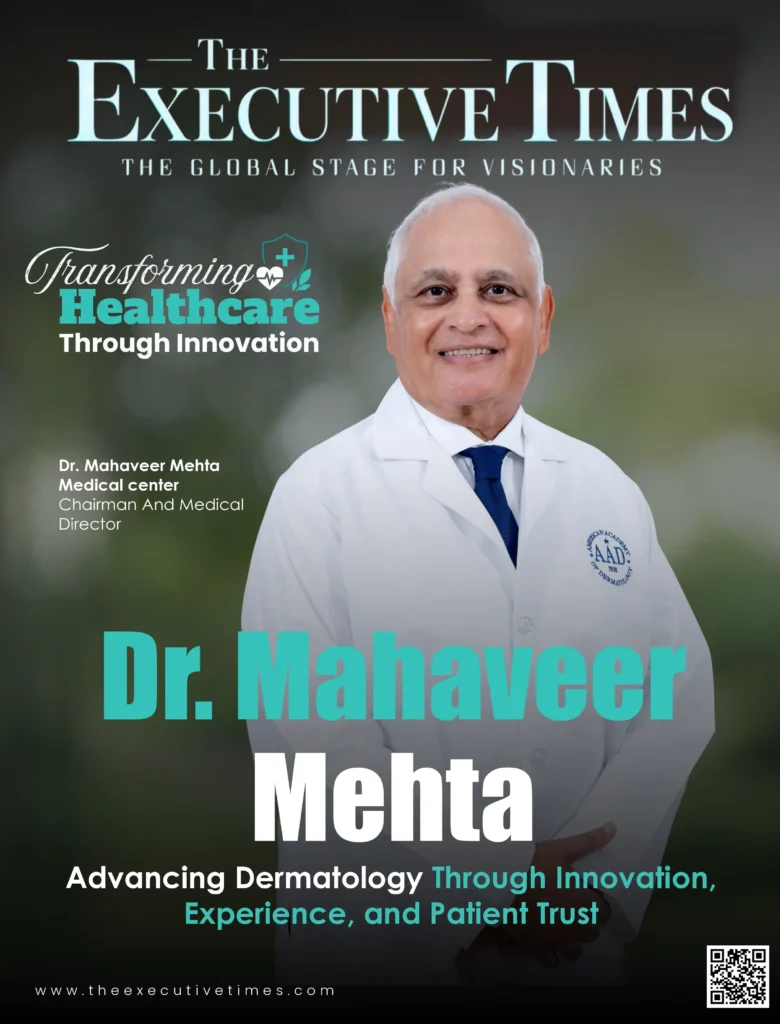
Dr. Mahaveer Mehta
Chairman And Medical Director at Dr. Mahaveer Mehta Medical center
"Dr. Mahaveer Mehta: Transforming Healthcare Through Innovation"
Dr. Mahaveer Mehta: Advancing Dermatology Through Innovation, Experience, and Patient Trust
From his early academic years in India to pioneering laser dermatology in the Middle East, Dr. Mahaveer Mehta has built a career around scientific progress, responsible treatment, and the enduring value of patient confidence.
Reading the Story Beneath the Skin
For Dr. Mahaveer Mehta, dermatology offered an opportunity to understand the human body through one of its most visible and complex organs. As a medical student in India, he became interested in the skin not simply as an external covering, but as a part of the body that can reveal underlying conditions and changes in health. This interest led him toward a specialty that combines clinical diagnosis, surgical precision, scientific knowledge, and aesthetic judgment.
He completed his MBBS at RNT Medical College in Udaipur in 1971. Dermatology appealed to him because it demanded several complementary skills: the ability to investigate symptoms carefully, the technical discipline required for procedures, and an understanding of the science behind changing treatment methods. That combination continued to shape his professional interests as medicine and technology advanced.
His early fascination became the foundation for a career spanning academic medicine, clinical leadership, international practice, and the introduction of new technologies. Across these settings, his focus remained on understanding the patient’s condition before deciding how it should be treated.
An Academic Foundation Across Borders
Teaching formed an important part of Dr. Mehta’s early professional life. He served on the faculty at SMS Medical College in Jaipur before moving to Al Fateh University in Tripoli, Libya. These academic appointments strengthened his commitment to medical fundamentals and the responsibility of explaining clinical decisions clearly.
The experience of teaching also reinforced the importance of sound reasoning. Medical education requires practitioners to examine their assumptions, justify their conclusions, and return to basic principles when faced with difficult questions. Those habits later became central to his approach to patient consultations and clinical practice.
Working in Libya introduced another lasting dimension to his understanding of medicine. Practising in a different cultural environment showed him that patients can approach healthcare with different expectations, beliefs, and concerns. The experience broadened his perspective and prepared him for subsequent leadership positions across the Gulf region.
Leading Dermatology in the Gulf
Dr. Mehta’s career progressed into senior clinical leadership as healthcare institutions across the Arabian Gulf continued to develop. He became Chairman of Dermatology at the International Hospital in Bahrain and later headed the Department of Dermatology at the Qatar Armed Forces Medical Unit in Doha.
These responsibilities extended beyond individual consultations. Departmental leadership required him to contribute to clinical systems, support younger doctors, and remain accountable for the quality of care delivered by teams. His work in a military medical setting also demanded discipline and attention to the responsibilities associated with patient care.
His professional experience across India, Libya, Bahrain, Qatar, and the United Arab Emirates gave him exposure to different healthcare environments and patient populations. Each appointment added to his understanding of institutional operations, professional collaboration, and the trust required to deliver care across cultural boundaries.
By the time he established his own practice in Dubai, he had developed experience not only as a dermatologist but also as an educator and clinical leader. That combination would become important in building a medical center around his own approach to treatment.
Building a Practice in a Changing Dubai
In May 1990, Dr. Mehta opened his medical center in Dubai. Establishing an independent practice at that time meant committing his professional future to a city that was still developing the international profile it would later acquire. His decision marked a significant transition from institutional appointments to building a long-term clinical practice of his own.
Over the following decades, Dubai’s development into an international healthcare and business destination created a changing professional environment. Dr. Mehta’s medical center grew alongside the city, allowing him to contribute to its healthcare landscape through continued clinical work and the development of dermatological services.
The center now operates from Al Ghurair Centre in Deira and has built relationships with patients across generations. Some have continued visiting for decades, while others recommend the practice through their own professional and personal networks. Such long-standing relationships reflect the value of consistency in a field where confidence in a physician develops through repeated experiences of care.
For Dr. Mehta, the longevity of the practice is closely connected to the responsibility involved in every consultation. Reputation may attract a patient initially, but maintaining trust depends on the quality of decisions made over time.
Bringing Laser Dermatology to the Region
One of the defining contributions of Dr. Mehta’s career has been his early introduction of laser dermatology to the Middle East. At a time when the technology was still unfamiliar to many patients and practitioners in the region, its use required careful explanation, clinical understanding, and a willingness to address uncertainty.
New equipment alone could not establish the value of a treatment. Patients needed to understand its safety, while medical professionals had to assess the evidence, limitations, and appropriate applications. Introducing laser procedures therefore involved more than adopting new technology. It required education, training, and the ability to determine which patients could benefit from it.
As dermatological technology developed, the center expanded its treatment offerings to include skin laser surgery, acne scar treatment, nonsurgical skin tightening, photofacials, intense pulsed light treatments, cellulite treatment, and pico laser technology. The latter has been used for applications including tattoo removal and skin rejuvenation.
Although the equipment and available procedures have changed over time, Dr. Mehta’s approach has remained consistent. Technology must be understood before it is used, its limitations must be recognised, and treatment decisions must be based on the needs of the individual patient.
The Clinical Judgment Behind Every Procedure
Dr. Mehta’s approach to treatment begins with three considerations: whether a procedure is scientifically appropriate, whether it is safe for the particular patient, and whether it is genuinely necessary. These questions place clinical judgment ahead of the appeal of a new device or a popular aesthetic trend.
His emphasis on necessity is particularly important in aesthetic medicine, where patients may seek to change visible features and practitioners can face pressure to offer additional procedures. Dr. Mehta maintains that a laser is a tool, not a diagnosis. The suitability of a treatment depends on the patient’s condition, skin type, clinical assessment, technical settings, and expectations.
His model of individualised care brings together accurate diagnosis, appropriate technology, correct technique, realistic expectations, and careful follow-up. Each element contributes to a treatment decision that considers the patient rather than focusing only on the procedure itself.
This philosophy also explains why he does not regard doing more as automatically producing better results. In some circumstances, observation, a conservative approach, or a decision not to proceed may be the most appropriate course. For him, responsible practice includes being willing to recommend against a procedure when it is not needed.
Staying Current in a Changing Specialty
Dermatology has changed substantially throughout Dr. Mehta’s career, moving from a stronger emphasis on clinical diagnosis and conventional treatments toward dermatological surgery, energy-based devices, and advanced aesthetic procedures. Keeping pace with these developments has required continued study alongside the demands of running a practice and caring for patients.
He regards complacency as a significant professional risk. Experience is valuable, but it cannot replace the need to learn as scientific knowledge and technology evolve. Physicians who stop updating their understanding risk falling behind, regardless of how long they have been in practice.
This commitment has extended into international conferences, academic presentations, research publications, and professional teaching. Dr. Mehta has attended and spoken at dermatology and laser conferences, mentored younger physicians, and contributed more than fifteen articles to scientific journals.
His professional recognition includes the Physician Recognition Award from the American Medical Association and the Continuing Medical Education Award from the American Academy of Dermatology. He has also served on the editorial boards of the Journal of Procedural Dermatology and the Journal of Clinical and Cosmetic Dermatology, as well as the editorial board of the Gulf Medical College health journal.
His international academic engagements have included invitations as chair, speaker, and faculty member at professional congresses, including a gender aesthetic congress in Singapore in 2014 and a dermatology and laser congress in Cannes, France, in 2015. These activities have allowed him to contribute to the exchange of knowledge among dermatologists working in different settings.
Connecting Dubai With the International Medical Community
Dr. Mehta’s contribution to dermatology has extended beyond introducing technologies into clinical practice. He has also worked to create opportunities for international medical professionals to meet, exchange knowledge, and strengthen professional connections in Dubai.
From 2013 to 2016, he served on the Board of Directors of the Dermatologic & Aesthetic Surgery International League, a United States-based nonprofit organisation. During this period, he advocated for bringing the organisation’s annual conference to Dubai. The proposal was accepted, and he was appointed Congress President for the meeting held in October 2016 with support from Dubai Tourism and the Government of Dubai.
The congress required coordination across scientific programming, speakers, sponsors, logistics, and delegates from different countries. Dr. Mehta also chaired the scientific committee of the International Congress in Aesthetic and Anti-Ageing Medicine, known as ICAAM, across several years beginning in 2013.
His work received formal recognition at the 2016 conference, when the American Society for Dermatologic Surgery presented him with an Outstanding Contribution Medal. Dubai Tourism and the Government of Dubai also presented him with the Congress Ambassador Award for his role in attracting and hosting international conferences, an honour he received again in 2020.
These achievements reflected his involvement in bringing international medical exchange to the emirate. He has consistently viewed professional collaboration as an important part of medical progress, with knowledge gaining value when practitioners share it across institutional and national boundaries.
Public Health and Service Beyond the Clinic
Dr. Mehta’s commitment to healthcare also includes humanitarian involvement and public awareness. He is a former Board Director of the Rotary Club of Dubai and has taken an active interest in philanthropic work alongside his clinical responsibilities.
Skin cancer awareness has been a particular focus of his public health efforts. His message centres on prevention, early diagnosis, and timely treatment. Changes in a mole, a persistent skin lesion, or unexplained pigmentation should not be dismissed simply because the area is painless or appears to be a cosmetic concern. Appropriate medical assessment can be important in identifying a serious condition at an earlier stage.
This perspective reflects his broader understanding of dermatology. Skin health is not limited to appearance; it forms part of overall health and wellbeing. While aesthetic treatments receive considerable public attention, dermatology also plays a role in recognising conditions that may require prompt medical intervention.
His emphasis on responsible care therefore extends beyond the treatment room. Educating the public, encouraging appropriate assessment, and helping people distinguish medical needs from aesthetic preferences are all part of the contribution he believes physicians can make.
Principles for the Next Generation of Physicians
When advising young doctors, Dr. Mehta places professional excellence ahead of the pursuit of recognition. He encourages them to develop a strong command of medical fundamentals, establish the correct diagnosis before selecting treatment, and understand the science behind every procedure they perform.
He also cautions against allowing marketing trends to dictate clinical decisions. New machines and emerging technologies may change how dermatologists work, but their adoption must remain guided by medical knowledge, sound judgment, ethical conduct, communication, and patient safety. He expects artificial intelligence and increasingly advanced equipment to influence the specialty, while maintaining that these core responsibilities will continue to matter.
Reputation, in his view, is built gradually through reliable decisions and can be damaged by a single careless one. This makes professional conduct as important as technical capability. The confidence patients place in a physician depends on the ability to listen carefully, explain options clearly, and act in the patient’s best interests.
For Dr. Mehta, the most valuable professional achievement is not being associated with the newest technology or the most fashionable procedure. It is developing the knowledge and judgment to determine when treatment is appropriate and how to deliver it responsibly.
A Career Still Focused on Learning
More than four decades into medicine, Dr. Mehta continues to focus on education, knowledge-sharing, and the development of younger dermatologists. His priorities include helping patients understand their treatment options and encouraging physicians to base their decisions on evidence, experience, and ethical practice.
He plans to remain involved in academic collaboration, scientific exchange, and the responsible adoption of new technologies. Rather than treating recognition as a final destination, he views professional achievement as an ongoing responsibility to contribute to the field and help others learn.
His journey has included academic appointments in India and Libya, departmental leadership in Bahrain and Qatar, the establishment of a long-standing Dubai practice, and participation in international medical conferences. Each chapter has added to his experience, but continued learning remains a central part of how he approaches the profession.
Patient Trust as the Lasting Measure
Dr. Mahaveer Mehta’s career brings together clinical experience, academic engagement, international collaboration, technological innovation, and public service. His professional record includes senior departmental appointments, a medical center established in 1990, an early role in regional laser dermatology, international congress leadership, and recognition from medical organisations and the Government of Dubai.
Yet his own measure of success returns to something more personal: the trust a patient places in a physician. Titles, awards, and technologies may change, but the responsibility to listen, diagnose accurately, explain treatment clearly, and prioritise patient wellbeing remains constant.
His advice to patients follows the same principle. A treatment should not be chosen simply because it is fashionable or promoted as the latest development. Patients should seek qualified, experienced professionals who can assess whether an intervention is appropriate in the first place. The objective should be safe, natural, medically suitable results, not change for its own sake.
In a rapidly evolving aesthetic healthcare environment, Dr. Mehta’s enduring contribution lies in bringing innovation and clinical judgment together. His work demonstrates a commitment to progress without losing sight of the individual receiving care, with patient trust remaining the standard against which every new development must be considered.