
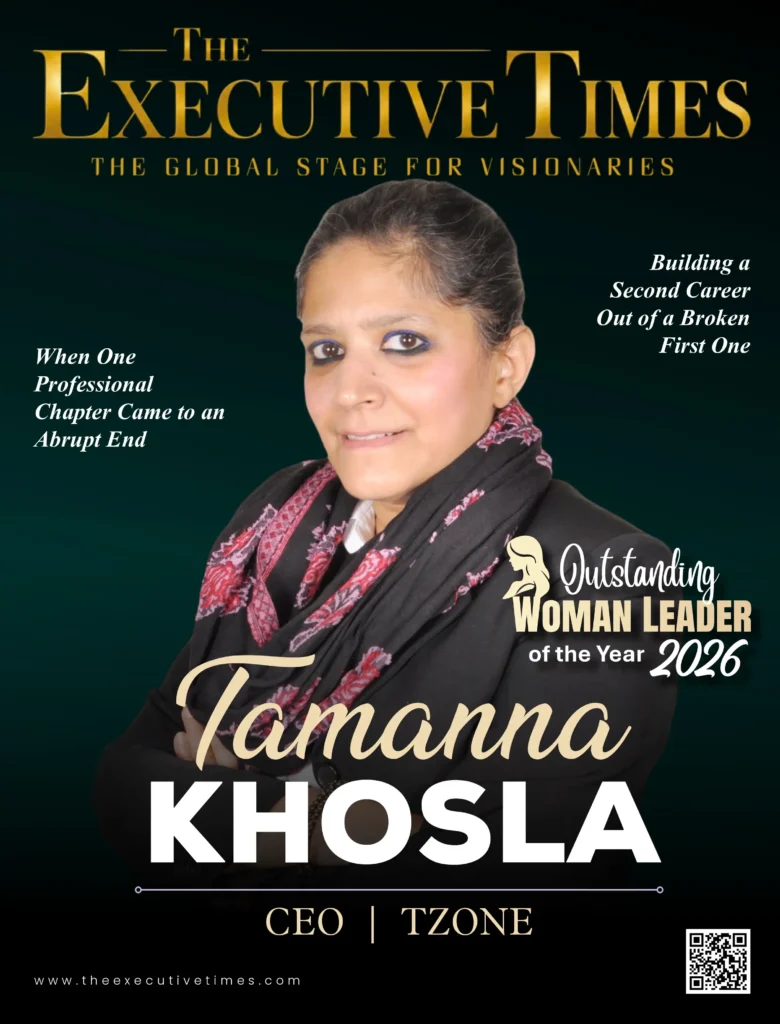
Cover Story -
Tamanna Khosla
CEO of TZONE
"The Most Influential Financial Growth Catalyst of the Year 2026"
Dr. Tamanna Khosla: Building a second career out of a broken first one
From an interrupted academic career to ten published books and a new institutional ambition, Dr. Tamanna Khosla continues to pursue the questions of power, freedom and oppression that have shaped her intellectual journey.
When one professional chapter came to an abrupt end
Dr. Tamanna Khosla’s career is a story of intellectual persistence through unexpected changes. Her academic journey began with an interest in science, but her curiosity gradually moved towards political science and the humanities during her senior secondary years. This shift eventually led her to Lady Shri Ram College, where feminism and international relations became important areas of exploration.
Her postgraduate studies at Jawaharlal Nehru University further developed these interests. Questions surrounding political power, gender and oppression became increasingly central to her thinking. By the time she pursued her M.Phil and PhD, her intellectual interests had expanded to include law and philosophy, bringing several disciplines into conversation with one another.
Her doctorate opened the door to an academic appointment at Delhi University. However, the opportunity did not develop into the long-term academic career she might have anticipated. Khosla says that academic hostility led to her removal and that opposition from a group within the system subsequently made it difficult for her to obtain another academic position.
The experience marked a significant interruption in her professional journey, but not an end to her intellectual work. Instead of abandoning the questions that had occupied her for years, she continued pursuing them outside the university system. She went on to write ten books, complete a law degree and establish herself as a public intellectual, legal scholar and feminist thinker.
Rebuilding a professional identity outside academia
The transition away from university life required Khosla to establish a different professional direction. Her academic experience had given her a foundation in political thought and research, while her legal education added another dimension to her understanding of institutions, rights and social structures.
Rather than confining herself to the traditional boundaries of an academic career, she developed an independent intellectual identity through authorship and legal scholarship. Writing ten books became a significant part of this journey, allowing her to continue engaging with ideas even after her academic appointment had ended.
Her path illustrates a distinction between holding an institutional position and continuing intellectual work. Although her university career was interrupted, her engagement with knowledge, philosophy and questions of social justice continued through other avenues.
Faith as her most dependable reference point
When discussing the principles that guide her decisions, Khosla places faith above professional models or analytical systems. Her belief in a higher power and spiritualism has remained a consistent source of direction throughout her life.
She describes faith as the one influence that has continued to support her when important decisions had to be made. Her belief in goodness and trust in God are closely connected to how she approaches uncertainty and evaluates the choices before her.
Alongside these convictions, she identifies an ability to understand people without openly revealing how closely she observes them. This quiet awareness influences how she interprets relationships and situations, allowing her to form judgments without making the process itself the centre of attention.
For Khosla, these personal principles are not separate from her professional journey. They form part of the foundation through which she has navigated difficult circumstances and continued to pursue her ambitions.
A habit of learning without boundaries
Khosla believes that useful knowledge can emerge from sources that people might not ordinarily consider. She describes herself as someone who can often recognise a possible solution before a problem has been fully articulated.
Rather than attributing this ability entirely to instinct, she connects it to constant learning and observation. People from different countries, individuals belonging to different generations, unexpected situations and even organisms can offer insights that influence how she approaches a challenge.
This willingness to learn beyond familiar academic and professional environments shapes her thinking. She does not believe that meaningful knowledge must come exclusively from established institutions or recognised experts. Almost anything can become an opportunity to observe, question and understand something new.
Such an approach also influences her ambitions for the future. She wants to create an environment where unconventional thinkers can explore ideas without being restricted by traditional disciplinary boundaries.
An institution for minds that challenge convention
Khosla’s proposed research organisation represents the next major direction in her professional journey. She envisions bringing together what she calls “nerds and geniuses” from different parts of the world, creating a space for individuals with exceptional intellectual curiosity and unconventional approaches to knowledge.
The proposed institution would examine a wide range of subjects, from contemporary global challenges to questions extending towards extraterrestrial possibilities. Its intellectual purpose would include developing new philosophical and legal frameworks while investigating oppression across race, class, gender, geography and society.
The breadth of this ambition reflects the multidisciplinary interests that have shaped Khosla’s own career. Political philosophy, feminism and law are not treated as isolated subjects within her vision. They provide different ways of examining the structures that influence human freedom and social relationships.
The larger objective is to bring people with different capabilities into a shared environment where they can investigate complex questions and contribute to new ways of thinking.
Five years focused on making the vision possible
For Khosla, the immediate priority is not simply to announce an ambitious institution, but to establish the financial foundation required to build it.
Her five-year vision centres on securing sufficient resources to recruit the people she believes can develop the organisation alongside her. She wants talented individuals to have access to what they need to pursue meaningful work without financial limitations becoming a constant obstacle.
This makes funding a practical requirement rather than an end in itself. The intention is to create the necessary financial runway, assemble the right group of people and give them the freedom to concentrate on research and intellectual exploration.
Khosla’s approach places considerable importance on the relationship between resources and opportunity. Financial support, in her view, should make it possible for capable people to contribute their abilities rather than prevent them from doing so.
The institution she imagines would therefore depend not only on intellectual ambition but also on the financial conditions necessary to sustain that ambition.
The personal history behind her interest in oppression
The questions Khosla wants to investigate are also connected to experiences she describes from her own life. She speaks of severe oppression within her family and across Indian society and academia, circumstances she says continued over several decades.
She describes facing these challenges as a woman without support from those around her. Throughout that period, she identifies God as the source of help she relied upon most.
These experiences provide personal context to her continued engagement with power, freedom and inequality. Her interest in oppression is not limited to academic analysis. It is also informed by the difficulties she says she encountered in her family, professional environment and wider society.
This connection between personal experience and intellectual inquiry is reflected in the proposed research institution, where examining oppression across different social structures remains one of the central objectives.
Respecting achievement without surrendering originality
Khosla’s advice to those seeking to develop their own influence is based on learning from accomplished people without losing their individual identity.
She believes intelligence and achievement should inspire curiosity rather than envy. Studying how others think and work can help individuals strengthen their own abilities, but she draws a clear line between learning and copying.
Another person’s work, she maintains, belongs to its creator. Respecting that contribution means recognising its originality while developing an independent direction.
Her perspective on financial resources follows a related principle. Money is necessary to support ambitious work, but it should not become the primary motivation behind an initiative intended to advance freedom and egalitarianism.
She wants exceptional thinkers to receive the respect, resources and independence required to pursue their ideas. This is the culture she hopes to establish within the organisation she is working towards.
A future built beyond the limits of one career
Dr. Tamanna Khosla’s professional journey has taken a different direction from the academic path on which it began. An interrupted university career did not bring her intellectual pursuits to a close. Instead, authorship, legal education and independent scholarship became important parts of a second professional chapter.
Her ambitions now extend towards building an institution that can bring unconventional minds together and support the development of new philosophical and legal perspectives.
The financial foundation she hopes to establish over the coming five years is central to making that ambition achievable. It represents an effort to create opportunities for people whose capabilities deserve the freedom and resources to develop.
The questions that first shaped her academic interests remain present in this next chapter: who holds power, how oppression operates and what conditions allow people to live with greater freedom and equality.
For Khosla, the end of one professional chapter did not mean abandoning those questions. It created the circumstances in which she began building a different path to pursue them.