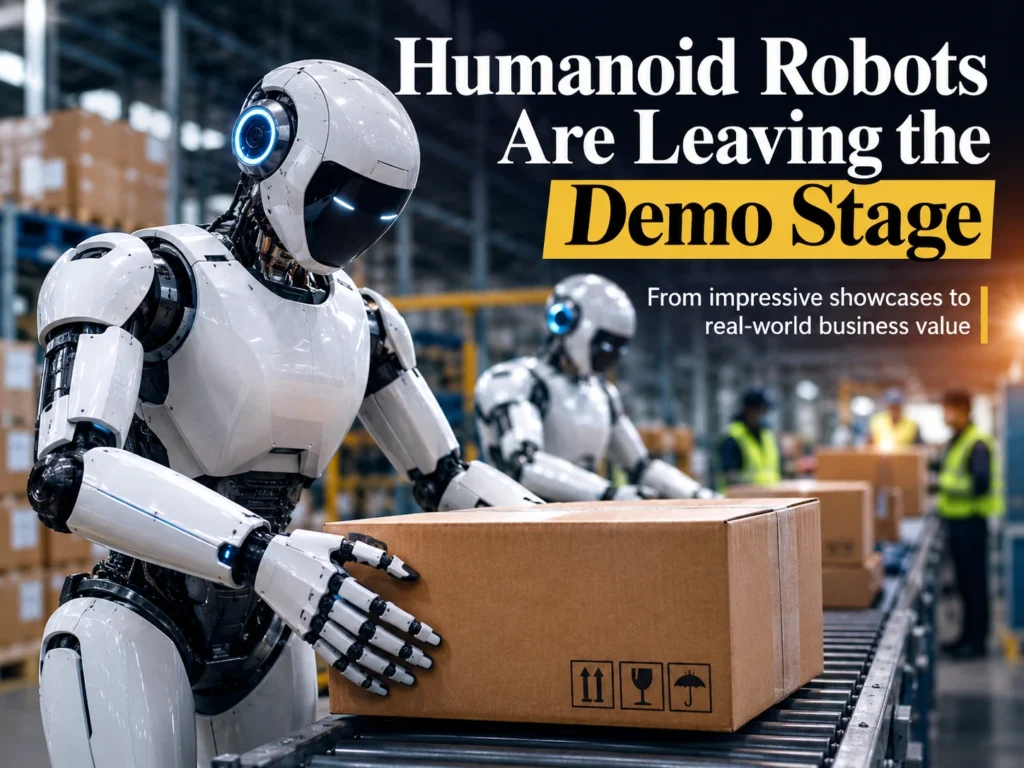
For years, humanoid robots have captured attention through impressive demonstrations, backflips, factory videos, and carefully controlled showcases. But the robotics industry is now entering a more important phase. The question is no longer whether humanoid robots can perform remarkable tasks. It is whether they can deliver measurable value in the real world.
As companies move from prototypes toward commercial deployment, humanoid robots are beginning to face the same test as every other business technology: can they solve meaningful problems, operate reliably, and justify their cost?
From Impressive Demos to Practical Applications
Demonstrations are useful for proving what technology can do, but businesses need more than impressive performances.
Factories, warehouses, logistics centers, and other industrial environments require machines that can perform repetitive tasks consistently, safely, and efficiently. Humanoid robotics is increasingly being evaluated against these practical requirements rather than simply technological milestones.
Manufacturing Is Becoming the First Major Test
Manufacturing environments offer one of the clearest opportunities for humanoid robots. Many factories already rely on structured workflows, predictable environments, and repetitive physical tasks.
Robots capable of moving materials, handling components, inspecting products, or supporting assembly processes could help companies address labor shortages while improving operational efficiency.
The challenge is proving that these systems can perform reliably over long periods rather than only during controlled demonstrations.
Commercial Value Matters More Than Technical Achievement
The robotics industry has made significant progress in mobility, perception, manipulation, and artificial intelligence. Yet technical capability alone does not guarantee commercial success.
Businesses must consider purchase costs, maintenance, energy consumption, downtime, safety requirements, training, and integration with existing systems.
A robot that can perform a task is impressive. A robot that can perform it economically at scale is valuable.
Artificial Intelligence Is Expanding What Robots Can Do
Modern humanoid robots are benefiting from rapid advances in artificial intelligence. Better computer vision, reasoning systems, and machine learning allow robots to interpret environments and respond to changing situations.
This could eventually allow humanoid robots to perform a broader range of tasks without requiring every movement to be explicitly programmed.
The combination of physical machines and increasingly capable AI is what makes this generation of robotics fundamentally different from earlier industrial automation.
Existing Workplaces Present New Challenges
Real workplaces are rarely as predictable as laboratories. Workers move unexpectedly, objects change position, equipment requires maintenance, and unexpected situations occur every day.
Humanoid robots must therefore demonstrate more than movement. They need to understand their surroundings, respond appropriately, and operate safely alongside people.
This ability to function in unpredictable environments may become one of the defining factors separating commercially viable robots from experimental machines.
Labor Shortages Could Accelerate Adoption
Persistent labor shortages are creating another reason for businesses to explore humanoid robotics.
Industries that struggle to recruit workers for physically demanding, repetitive, or undesirable tasks may see robots as a way to supplement human teams.
Rather than replacing every employee, early deployments may focus on taking over specific tasks and allowing workers to concentrate on responsibilities that require judgment, communication, creativity, and oversight.
Scale Will Determine the Winners
Building a small number of advanced robots is very different from producing thousands or millions of reliable machines.
Manufacturers must develop efficient supply chains, standardized components, software platforms, maintenance networks, and production systems capable of supporting large deployments.
The companies that solve these scaling challenges may gain an advantage that goes beyond the capabilities of the robots themselves.
Human Workers Will Remain Part of the Equation
The rise of humanoid robots does not automatically mean the disappearance of human workers.
Businesses will still require people to supervise systems, manage exceptions, maintain equipment, make decisions, and improve operational processes.
The more realistic future may therefore be one where humans and robots work alongside each other, with machines handling physical repetition while people focus on higher-value activities.
The Robotics Race Is Becoming a Business Race
As humanoid robots move beyond demonstrations, competition will increasingly depend on economics rather than spectacle.
Companies will need to prove that their machines can work reliably, integrate into existing operations, and generate returns that justify investment.
That changes the nature of the robotics race. The winners may not simply be the companies building the most advanced robots, but those capable of turning advanced robotics into sustainable businesses.
The Bottom Line
Humanoid robots are entering a defining moment. The technology has already demonstrated that machines can walk, manipulate objects, navigate environments, and perform increasingly complex tasks. The next challenge is far more demanding: proving that these capabilities can create real commercial value.
As robots move from stages and laboratories into factories, warehouses, and workplaces, the industry will be judged less by spectacular demonstrations and more by productivity, reliability, safety, and return on investment. The demo era may be coming to an end. The business era of humanoid robotics is beginning.